



Quick Facts About Buying a Used Car
- The average used-car listing price in September rose to $27,235, the highest monthly average since December 2022.
- Used-vehicle inventory recovered slightly in September to a 49-day supply amid typical seasonal sales slowdown.
- Used cars remain a solid value proposition this fall if you can find one that meets your needs. Options under $15,000 are scarce, with a 34-day supply and account for just 15.7% of all used-car inventory.
The average used-car listing price reached $27,235 in September, surpassing August’s revised figure and marking the highest monthly average since December 2022. That’s about 6% higher than the same time last year, adding to the affordability challenges facing shoppers. However, with the average transaction price (ATP) of a new vehicle reaching $50,562 in September, used vehicles remain a good alternative. If you’re looking to jump into the used-vehicle market this fall, be aware that demand remains high and supply tight.
A modest inventory increase doesn’t signal a major market shift. Shoppers who find a used vehicle that fits their needs and budget may want to act rather than wait for prices to fall. That advice is especially relevant for buyers shopping below $15,000, where inventory remains particularly limited.
Many factors can influence whether it’s a good time to buy a used car, including inventory, credit availability, and loan interest rates. Limited inventory may require some flexibility in your search. Depending on your circumstances, you might consider increasing your budget for a newer vehicle, keeping your current car and setting aside money for repairs, or broadening your search for a suitable used model. If you’re wondering if now is the time to buy used, here’s what you need to know about the current market.
- Used Car Market Overview
- How Much Does a Used Car Cost?
- EV Perspective
- Pros and Cons of Buying a Used Car
- Tips for Buying a Used Car in Today’s Market
- Bottom Line
Used Car Market Overview
At the start of 2026, Cox Automotive economists predicted a modest used-vehicle sales decline for the year due to economic pressures and constrained supply. Cox Automotive is Autotrader’s parent company. Sales have generally followed that forecast, although tax refunds and affordability challenges in the new-vehicle market helped boost demand in March. Sales also improved slightly in July and August before slowing by 6.3% in September. Still, September sales were 2% higher than a year earlier.
The September slowdown followed a typical seasonal pattern, although the decline was milder than in recent years. Used vehicles continue to provide a strong value proposition compared with new ones, and more late-model vehicles are entering the market. Sales of used vehicles under three years old are noticeably higher than a year ago.

“After a September that depreciated faster than normal, wholesale values firmed in early October,” said Cox Automotive Senior Director Jeremy Robb about September’s Manheim Used Vehicle Value Index. “This strong start to October cannot undo a soft third quarter. The trends we flagged in September haven’t gone away: higher rates and weaker sentiment. If anything, we might have seen some of the weakness we expect to see in October pulled ahead into September after a stronger-than-expected first half. October has started on steadier ground, but we will need the full month to know whether it will hold.”
The war in the Middle East continues to create uncertainty about fuel prices, while broader economic pressures continue to strain household budgets. That leaves car shoppers facing average new-car prices hovering around $50,000 and limited supply of used vehicles in the most affordable price ranges. Many consumers are opting to keep their vehicles longer, but older vehicles can come with unexpected repair bills.
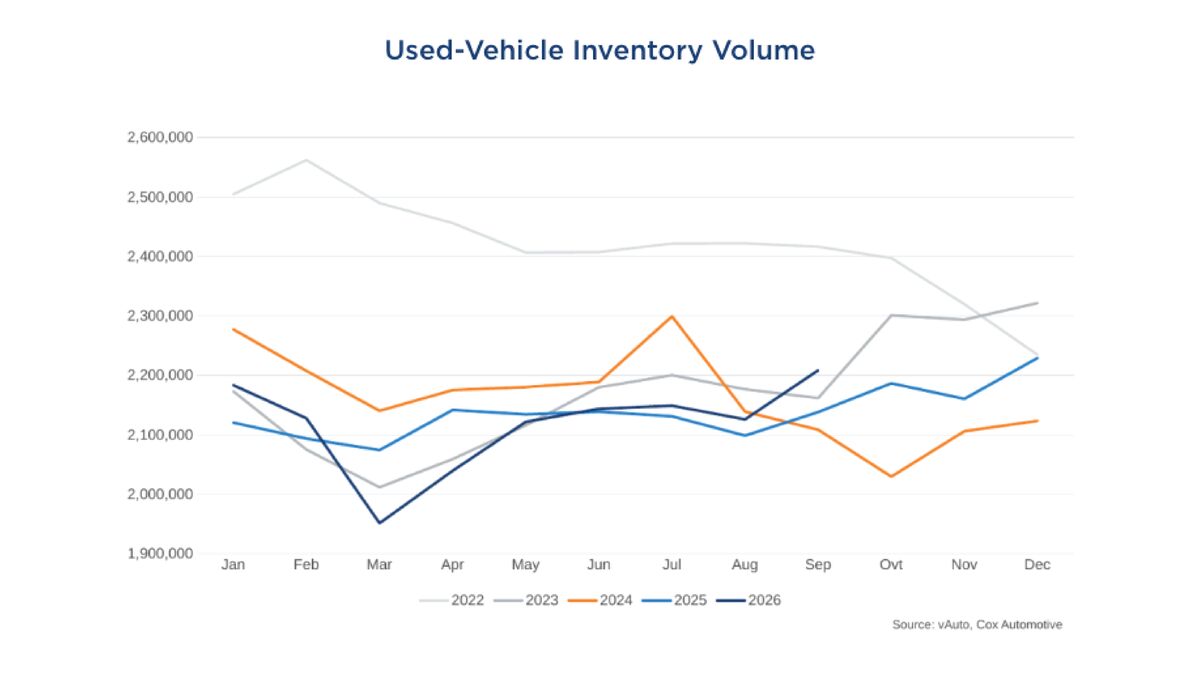
Total used-vehicle inventory reached 2.21 million at the end of September. This was up 3.3% year over year and 3.9% from August. Despite the improvement, inventory remains constrained. Supply exceeds the September 2023 and 2024 levels but remains below the 2.42 million vehicles available in September 2022.
Manufacturers made 8 million fewer new vehicles from 2020 to 2022 due to COVID-19 supply disruptions. Unable to find new vehicles to buy or lease, many buyers turned to used cars, tightening the supply of used vehicles. Fewer leases during that period also mean fewer off-lease vehicles returning to the used market, a shortage that could persist for several years.
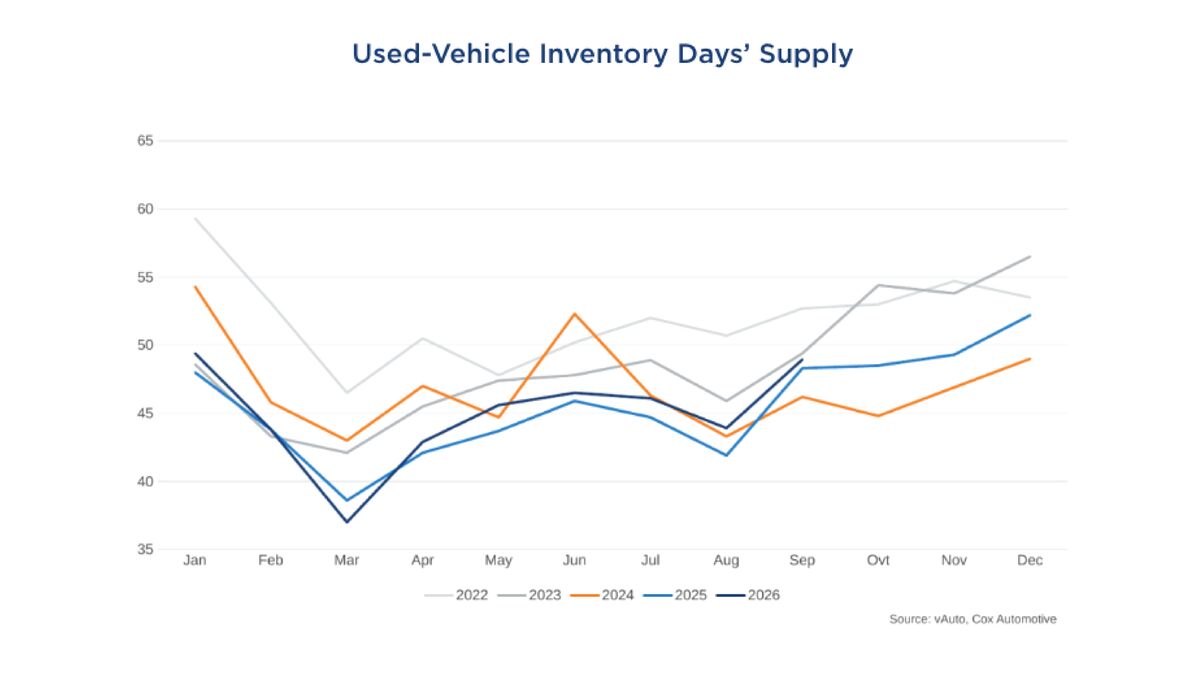
The latest Cox Automotive days’ supply report shows that the used-vehicle supply was 49 days in September. This number was up from 44 days in August and 48 days a year earlier. The 6.3% decrease in sales pace, combined with a 3.9% increase in inventory volume, contributed to the higher supply figure.
RELATED: Used Car Buying Guide
How Much Does a Used Car Cost?
The average used-car listing price in September was $27,235, up 6% from the same period in 2025 and essentially flat compared with August’s revised $27,223. September marked the third month in 2026 that the average exceeded $27,000, a threshold we have not seen since summer 2023.
Options in the most affordable used-vehicle pricing band — $15,000 and under — remain limited. Older vehicles typically cost less, but shoppers wth smaller budgets face an uphill battle. The segment had just a 34-day supply in September, 15 days below the overall used-vehicle average. Inventory in this price range fell 16.2% year over year, accounting for only 15.7% of all used vehicles for sale.

Buyers who aren’t paying in cash will need to finance their purchase. Auto loan interest rates have remained high for the past several years, making it harder to afford a used car. Use our car affordability calculator to see what fits your budget. If you are ready to shop, narrow your search by filtering cars for sale by owner, at a dealership, or in a certain price range.
Sales of certified pre-owned (CPO) vehicles in September increased 10% year over year, but were down 6% from August. September’s CPO sales are estimated at 213,525, down from 227,204 in August. CPO sales continue to outperform the broader used-vehicle market, and CPO vehicles accounted for 15.8% of total used-vehicle retail sales in September. CPO vehicles are typically low-mileage cars in excellent condition and backed by the manufacturer. With an extra warranty, certified pre-owned vehicles can be a good deal, especially if they come with special financing offers.
“As new car prices rise, considering an older used car can be a smart move,” said Chris Hardesty, Autotrader senior advice editor. “If you do careful research and find a solid, reliable model, it should last many years.”
RELATED: What Is a Certified Pre-Owned Car?
EV Perspective
Used electric vehicle (EV) sales increased again in September, reaching an estimated 47,862 units. That’s up 12.3% month over month and 21.2% year over year, with EVs accounting for 3.3% of total used-vehicle sales, up from 2.9% in August. Tesla continued to lead used EV sales, followed by Ford, Chevrolet, Hyundai, and BMW.
Inventory for used EVs tightened in September. Days’ supply fell to 35, a 16.7% decline from August but a 21.3% increase from a year earlier. Used EV supply stood 11 days below that of gasoline-powered and hybrid vehicles, the largest gap in 2026. The two categories reached parity just a month earlier.
The average listing price for a used EV in September was $36,767, down 1.8% month over month but up 6.4% year over year. Although Tesla’s average listing price rose 1.4%, declines among other high-volume models, including the Nissan Ariya, Cadillac Lyriq, BMW iX, and Chevrolet Blazer EV, pulled the overall average lower.
“The EV market continues to adjust following last year’s federal tax credit expiration, with new and used EV markets showing increasingly different dynamics,” said Cox Automotive Director of Industry Insights Stephanie Valdez Streaty. “Used EV sales continue to grow as pricing moves closer to ICE+ vehicles and more off-lease EVs enter the market. Sales, inventory, pricing and incentives will remain key indicators to watch.”
As more off-lease EVs and trade-ins enter the market, shoppers have a growing selection of models beyond Tesla. Even with September’s tighter inventory, the expanding variety gives buyers more choices than in previous years.
Pros and Cons of Buying a Used Car This Month
| Pros | Cons |
| ✔ On average, used cars are selling at a little over half the cost of new vehicles, though inventory remains constrained. If you find a vehicle that matches your needs, it could be wise to jump on it now. | ➖ Waiting for lower car loan interest rates may make sense if you need to finance your purchase. However, there’s no certainty about when rates will decline. |
| ✔ New cars quickly depreciate once driven off the lot, making a used car a potentially better value. | ➖ Buying a newer-model used car can sometimes cost more than a comparable new one. |
| ✔ Insuring a used car costs less than insuring a new vehicle in most cases. | ➖ Limited inventory may mean you can’t find the car you want in your preferred color or trim. |
Tips for Buying a Used Car in Today’s Market
With several factors impacting the purchase of a used car, use these tips to find the right vehicle for your budget.
- Research used car models to find the best deals from dealerships and private sellers.
- Ask for a vehicle history report to learn about its maintenance and any accidents.
- Check the used car’s Kelley Blue Book value from our sister site to see if it’s a good deal.
- Get the best offer on your trade-in by shopping it around.
- Compare rates for your used car loan before settling on financing.
- Set your budget and use our car affordability calculator to determine what works best for you.
- Look for certified preowned manufacturer offers and other deals.
- Obtain quotes for car insurance before buying.
- Avoid signing any sales agreement before seeing a cost breakdown of all charges.
Bottom Line
Used car inventory saw an increase in August, but the average listing price rose, likely due to a greater influx of younger used vehicles onto the market. The used vehicle market remains tight overall, especially compared with the new vehicle market. Those looking for a vehicle under $15,000 continue to face thin inventory, though supply did get a small boost in September. Used vehicles remain an affordable alternative to new ones. Given inventory constraints, you might not find the exact vehicle you want. In this market, if you find a used vehicle that fits your needs and works in your budget, consider acting quickly. Consider your personal circumstances when deciding whether it’s the right time for you to buy a car. Research before deciding to buy used, and if it’s a newer used vehicle, be sure to check the prices of new models and compare costs.
Visit Autotrader’s Car Buying Information Center for curated articles, resources, and tools to guide your shopping journey.
Editor’s Note: We have updated this article since its initial publication.


Is it better to buy a car near the end of the month when dealers need to make up their numbers?
Hi Lanie. Thanks for reading. You may have more negotiating leverage at a dealership toward the end of then month. Take a look at our article When Is the Best Time to Buy a Car? (https://www.autotrader.com/car-shopping/when-is-the-best-time-to-buy-a-car) for tips on other times that can be better for car buyers.
The best advice I received about buying a vehicle is to be patient and don’t fall in love with anything you see or test drive. Buy a vehicle you can afford, and drive it until the wheels fall off! Oh, and buy used!
Excellent article! Buying a used car can be a smart financial decision, but only if you do your homework. A thorough vehicle history check, complete service records, a detailed test drive, and an independent pre-purchase inspection can help you avoid costly surprises. Mileage is important, but the overall condition and maintenance history matter even more. Thanks for sharing such practical advice for anyone considering a used car purchase!
Drifolio has made buying and owning used vehicles a lot easier for me because it keeps maintenance records, receipts, mileage history, and ownership history organized in one place.
One thing I think buyers underestimate is how important maintenance history becomes when inventory is tight and prices are elevated. Two vehicles can look identical on a listing site, but the one with documented oil changes, repairs, tire replacements, and service records is usually the safer purchase.
The article is right to emphasize checking vehicle history and maintenance records. A lot of people focus on mileage and forget that how a vehicle was maintained often tells a much bigger story.
Whether you’re buying from a dealer or a private seller, I’d rather see complete service records than hear someone say, “Trust me, it’s been maintained.”
My grandson just perchased a 2016 Kia on Facebook market place. Beautiful car like new inside but uses four quarts of oil per ten/fifteen gallons of gas
Can someone explain the annual dip in Days of Supply that appears to bottom out each March?
How much impact does that have on the price of used cars?
Finally, should prospective buyers wait a month for those numbers to recover before buying or is that likely to be when prices become affected by tariffs?
Thanks for reading, Darrel. The dip is all about tax refund season. Tax refunds drive the highest demand of the year because buyers have more money to use as a down payment. More money in consumers’ pockets means more demand soaking up supply. In general, supply rises after tax refund season for the rest of the year. Last year, sales stayed higher than normal through December, so dealerships didn’t get to ‘rebuild’ supply as much as usual and we started off 2025 lower than we normally do.
Wholesale prices usually rise due to tax refunds, and impact retail prices with a 4-6 week delay. February and March often see lower retail prices because dealers bought cars in December when prices are lowest. Tariffs could further increase used retail prices.
My comments are:
Can we ask why is this president hurting consumers ?
Can organizations question the president ti stop this?
You can ask anything. The President isn’t hurting consumers, he’s actually helping them. Many manufacturers have announced that they’re moving production into the US which will result in more American jobs and tax revenue. We shouldn’t question him to stop it, we should question him why he’s not moving faster.
consumers barely can afford prices now. He isn’t helping anyone
no ones going work those jobs.
stop living in fancy land he’s destroying our economy and making his friends rich
Nancy, You are so misguided! Our economy is booming. Just look around. I live in Canton Ohio. I have driven by the Canton/Akron airport for years. The parking lot was always half full. There was grass growing on it and now the lot is always full and they are paving it. Another example: I stopped at the library and the librarian told me she now spends all day getting passports for people. If you cannot get a job now there is something wrong with you! What jobs are you referring to when you say no one will take those jobs? He is making everyone better not just the rich. The middle class are doing so well. Border is secure and taxes are lower. I could go on and on with other examples.