



Here’s How to Stay Safe While Car Shopping

Quick Facts About Dealership Spoofing Scams:
- Scammers are using artificial intelligence (AI) to quickly create spoofs of legitimate dealership websites. These websites come complete with photos, videos, and attractive prices.
- These false websites advertise buy-back guarantees and warranties and send “trust kits” containing falsified information meant to lull victims into a false sense of security, where they ultimately wire funds in irreversible transactions.
- The use of AI means scams can evolve more quickly than ever. While the specific tactics we explain in this article may evolve or look different, there are some foundational steps all car shoppers can take to stay safe.
You’re starting your search for a new or used car. Where do you begin? Unless your very first stop is a local dealership, you will almost certainly do some research and browse online first. In fact, in a time where you can order pretty much any conceivable item via app or website, vehicles are no exception, and you may even consider making a remote purchase. New data from Cox Automotive’s Car Buyer Journey Study indicates that as high as 28% of car shoppers would like to complete the transaction entirely online.
The dark underbelly of that convenience, however, is that it can expose you to a higher rate of fraudulent activity than in-person shopping might. That’s not to say every brick-and-mortar dealership is 100% on the up and up, but the anonymity of the internet can certainly make it easier for scammers to exploit their victims. AI has also enabled ever-increasing sophistication in how they do so.
If you’re looking to purchase a vehicle, be aware that fraudulent websites are cropping up more frequently, even though they resemble legitimate dealership sites. Here’s what the scam entails and how to take an active role in protecting yourself.
How Is AI Playing a Role in Scamming Car Buyers?
Is the website you are visiting legitimate, or is it a duplicate, created by scammers? The Fraud Intelligence Team at Point Predictive, a risk management consulting firm, reports that “dealer cloning” is gaining traction as a scamming technique targeting car shoppers specifically.
Scammers use AI to create spoofs of entire websites belonging to real dealerships. “Generative AI in particular makes everything faster and more efficient, and that includes fraud activity,” explained Joey Yates, AVP of Business Services at Cox Automotive. This means that fraudsters can “manufacture a website using stock templates that look just like all the other websites that are out there. They can very easily create a listing of inventory that looks just like you would find on a legitimate website. They can even use video testimonials from fictional characters,” said Yates.
Scammers will post stolen inventory images, false testimonial videos, and vehicles advertised at prices well below market value to entice buyers. These sites haven’t just been cropping up for regular passenger vehicles either; they also advertise tractors and heavy equipment.
Unsuspecting buyers will contact these false dealers, who walk them through what appears to be a legitimate process. Ultimately, the victim wires the money for the vehicle or equipment, sometimes to the tune of five or even six figures. The website then disappears, along with the victim’s money. It’s a devastating prospect, and there’s currently no recourse for recovering funds sent through irreversible wire transfers.
What Are Some Hallmarks of These Types of Scams?
Point Predictive examined more than 100 cloned dealership websites and identified several consistent aspects of the scam across the sites:
- Professional Website, Too-Low Prices: The websites appear slick and professional, with full vehicle details, images, and in some cases even video. However, prices on the false sites were typically 30-50% below market value.
- 14-Day Buy-Back Guarantee: While not necessarily an immediate red flag, because legitimate dealerships and certified pre-owned (CPO) programs may offer them, be wary if they appear alongside other items on this list.
- 30-Day Mechanical Warranty: Again, dealerships and CPO programs do offer these types of warranties, so one may not necessarily be an immediate red flag but it is something you will need to investigate further.
- “Trust Kit”: Perhaps the most distinctive feature of these scams, if a “trust kit” is offered, you need to be on high alert. In the dealership spoofing scams that Point Predictive analyzed, “trust kits” containing falsified documents such as VIN verification, dealership credentials, and vehicle photos were sent to buyers in advance of payment to lull them into a false sense of security that they were involved in a legitimate transaction.
- Irreversible Payment Demands: The final nail in the coffin of these scams involves demanding an irreversible wire transfer. Wire transfers, ACH payments, and cashier’s checks are all irreversible payment methods that can be difficult or impossible to recover once sent. In some cases, scammers request a deposit first, and then, before “shipping,” demand the full balance.
Although these trends have been clearly identified in current scams, they’re likely to evolve as shoppers and law enforcement catch on and scammers try to remain a step ahead.
For example, the term “trust kit” may eventually take on new names, but the fundamental idea of providing a set of false documentation to gain a buyer’s trust could remain a foundation of these types of scams.
How to Protect Yourself From AI Scams
These AI spoofing scams are sophisticated, but they aren’t perfect, and they do follow patterns. While the methods they use and the language they employ may shift, there are some foundational steps shoppers can take to verify the legitimacy of a dealership or transaction. While none of these are perfect solutions, using a combination of them during your car search can help keep you safe.
Go in Person
The best way to debunk an online scam is to simply visit the dealership in person. A dealership that is where it says it is and has real people available to complete the transaction isn’t something scammers can easily replicate with false websites.
Know the Reasonable Value of the Car You’re Considering
One of the easiest red flags to spot during car shopping is a vehicle priced suspiciously low. “I always go back to that same thing our grandmothers and grandfathers used to teach us years ago,” said Yates, “which was if it sounds too good to be true, it probably is.”
Start by knowing the manufacturer’s suggested retail price (MSRP). You can find this on the manufacturer’s website for the model you are considering. This should give you a starting point for what a dealer might ask. Of course, prices can and will vary based on location and demand, so it’s also worth cross-checking with pricing and valuation tools from a trusted source, like Kelley Blue Book.
Check out comparable vehicles for sale on Autotrader, where you can see what cars are typically selling for in your area. Doing this will give you a good baseline for what the car you’re considering should reasonably cost. If you’re seeing a website listing prices that are 30-50% lower, that should definitely raise your suspicion.
Check the Website History
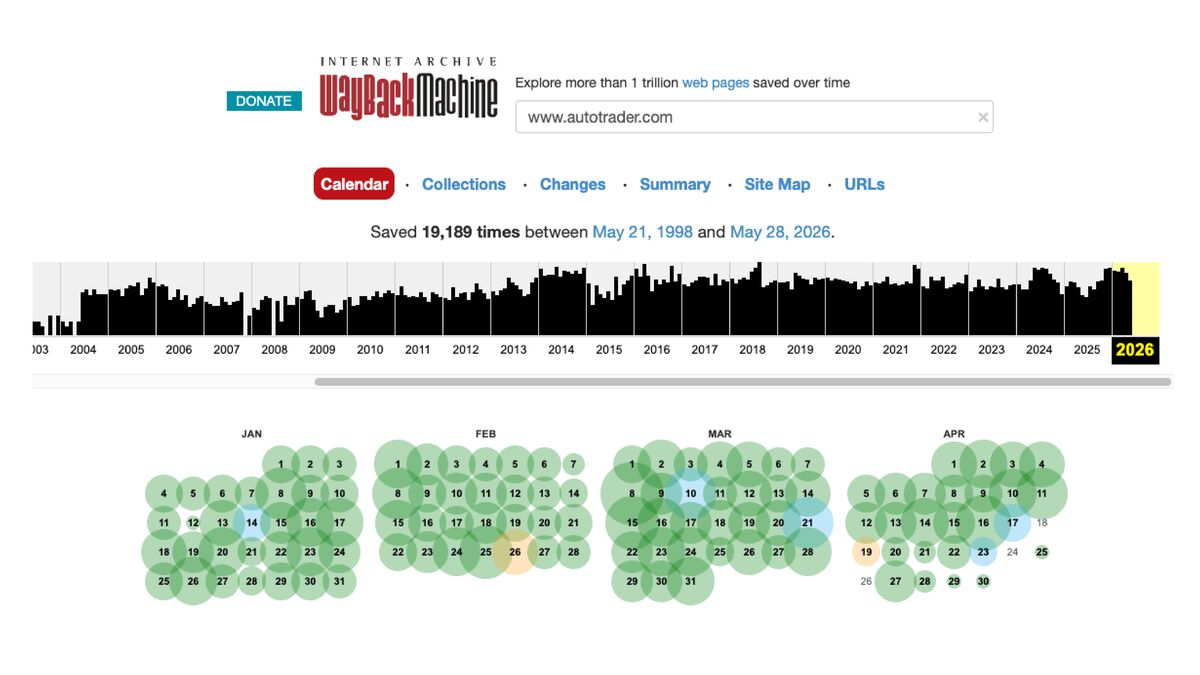
One simple check you can perform for a website is to see how long it has been around. Many of these spoofed websites are created quickly and disappear once the scam is complete, only to be recreated with a new URL.
The Wayback Machine is an initiative of the nonprofit Internet Archive that maintains a digital library of websites, even those that are no longer live or functioning. You simply search for the URL of the site you are reviewing, and you’ll be able to see how long the site has been around. Unless it just opened, a legitimate dealership will likely have a longer history and web presence. It’s worth checking, especially for a dealership that you can’t visit in person.
Be on the Lookout for Issues With AI Images and Video
When you’re looking at images and videos on dealership websites, examine them carefully, especially if anything seems a little off. “Even as good as AI has gotten, there still are some fairly telltale signs,” explained Yates. “A lot of the time the words that you’re hearing won’t quite match the lip movement of the speaker in a video…if you drill in on the hands, in particular, in AI-generated images, you might see a sixth finger or a fingernail coming out the back of the wrist.”
Certain lines of a car may not quite match up, the shadows in the parking lot could be inaccurate, or three pedals could appear instead of two. You don’t have to take a magnifying glass to every image you look at, but just be aware that in this new AI landscape, not every image may be real.
Confirm Dealership Legitimacy With a Trusted Site
If you’re committed to the online-buying process and are willing to forgo a test drive with the dealer, you must confirm dealer legitimacy. One of the best ways to do this is to cross-check with a trusted site, like Autotrader, where you can search for real dealerships and verify their locations and information.
Recognize False Urgency
Pressure can lead to snap decisions, and it’s one of the best tools a scammer has. “If somebody is creating a sense of urgency, then there’s a risk that there’s fraud involved,” warned Yates. “If somebody is asking you to send some money as a deposit or send some money as a goodwill gesture or anything like that, there’s probably fraud that’s involved.”
Most real dealers, even in a digital transaction, will want you to come in person in the hope of making further upsells. If you’re talking to a “dealer” and they are actively discouraging you from trying to visit in person, that is a serious red flag.
A car is a major purchase, and it’s very easy to let emotions get involved in the process. This is something scammers will exploit to the fullest. Always take a deep breath and remember that no car-buying decision needs to be made under extreme pressure. You can always walk away, gather your thoughts, and come back to the process. If the “dealer” you’re talking to is doing everything in their power to try to prevent that from happening, you need to treat the transaction as a potential scam.
The Bottom Line
Scams are nothing new, but AI creates sophisticated and unique opportunities for fraudsters to take advantage of shoppers. The spoofing scam outlined above will inevitably evolve, and scammers will always adapt their tactics, but you can still take steps to protect yourself. This starts with being an informed shopper.
Never go into car-buying blind. Know the numbers behind the vehicle you’re considering and do some comparison shopping in your area. Make sure you have a financing plan. When in doubt, go in person to a brick-and-mortar location. And finally, take a deep breath; you never have to make a decision on the spot, and if you feel pressured in any way, it is absolutely okay to step away, gather your thoughts, and stay safe.


