


Used Hyundai Santa Fe Quick Facts
- The best used Hyundai Santa Fe is the newest one with the fewest miles, but if your budget doesn’t allow that, we’d opt for a fourth-generation Santa Fe that ran from 2019-2023. The Sante Fe has one of the longest standard warranties in the business.
- Hyundai started building the Santa Fe in 2006 at its plant in Montgomery, Alabama.
- The newest Hyundai Santa Fe offers 3-row seating and a near-luxury-like interior.
The Hyundai Santa Fe has been around for more than two decades. During its long run, the Hyundai Santa Fe has undergone numerous design changes, all based on the idea of a sturdy, family-oriented SUV that offers the option of all-wheel drive (AWD) and comes loaded with the industry’s latest technology. As a used SUV choice, the Santa Fe has much going for it, especially if you buy a newer model with a factory warranty. Early models had some issues with long-term reliability. However, with each generation, Hyundai has worked to make the Santa Fe more reliable. Later models offer a hybrid powertrain, advanced driver-assist system, and bold color and wheel options. Read on to learn about the Hyundai Santa Fe’s best model years for buying used, towing capacity, warranty information for used car buyers, and more.
Logically, the best used Sante Fe would be the newest one with the least miles. However, if your budget doesn’t allow it, we’d opt for one of the fourth-generation Santa Fe years that runs from 2019-2023. It offers a choice of engines, including turbocharged and hybrid, plenty of advanced driver-assists, and a wide selection of trims and features without busting the bank. If your budget doesn’t allow for a newer model, you’ll probably be OK going back no further than 2015, which covers the third-generation Santa Fe and Sante Fe Sport. Unless you find an absolute peach, anything older than 2015 will likely run into high mileage issues, such as excessive wear and tear and possible rust issues.
See used Hyundai Santa Fe models for sale near you.
Hyundai Santa Fe by Generation: Which Should You Buy?
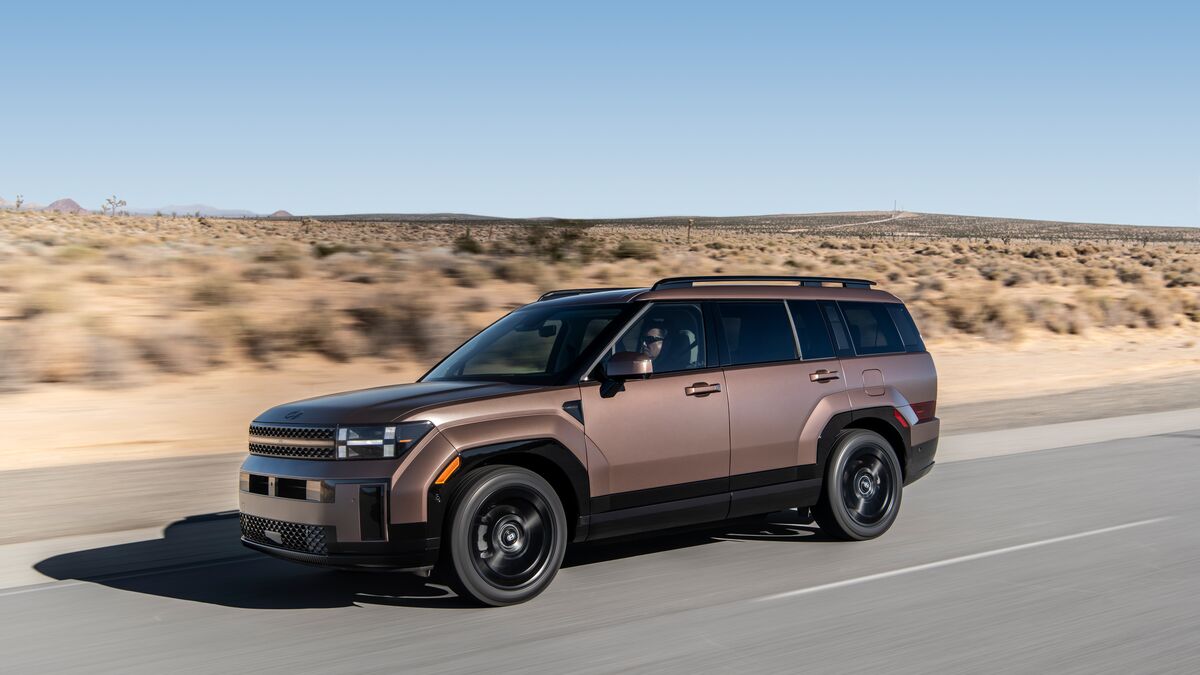
Fifth Generation: 2024-Current
All new for 2024, you may not find many fifth-generation Santa Fe models on the used car lot, but if you do, there’s a lot to like. The boxy styling is a far cry from the previous generation, as is the ultramodern interior featuring standard 3-row seating. Other perks include an available hybrid engine, a more advanced driver-assist system, a huge digital instrument cluster, and a revised XRT trim designed to venture off-road.
Model-Year Changes:
2026: Updated transmission, new interior color choices and configuration options, and new available safety features.
2025: New Atlantis Blue paint color.
See 2024-to-current Hyundai Santa Fe models for sale near you.
Fourth Generation: 2019-2023

The fourth-generation Santa Fe replaces the previous generation Santa Fe Sport, returning to its roots as a 2-row, 5-passenger SUV. This generation probably makes the most sense for used car shoppers as it may still fall within the warranty period and offers the latest in infotainment, safety, and high-tech. We should also point out that Hyundai continued to build the previous 3-row Sante Fe as a 2019 model, dubbing it the Santa Fe XL.
There is much to like with this generation of Santa Fe, which offers four trims (SE, SEL, SEL Plus XRT, Limited, Ultimate, and Calligraphy, depending on the model year) and four engine options. A 2.4-liter 4-cylinder good for 185 hp comes standard, with the Limited and Ultimate trims offering an optional 235-horsepower turbocharged 2.0-liter 4-cylinder engine. Later in the model run, a hybrid, plug-in hybrid, and the rugged-lite XRT and posh Calligraphy models join the lineup.
The base SE includes air conditioning, power windows and door locks, a 7-inch touchscreen infotainment setup with Apple CarPlay/Android Auto capability, automatic emergency braking, adaptive cruise control, and lane centering. Moving up to the SEL brings heated side mirrors, proximity keyless entry, a power driver’s seat, and heated front seats. Options for the SEL include a power liftgate, dual-zone climate control, and a 12-speaker Infinity sound system.
Moving to the Limited adds more features, such as leather seating, a power passenger seat, and a panoramic moonroof. The Ultimate trim brings heated and ventilated front seats, a surround-view monitor, heated rear seats, a heated steering wheel, a head-up display, and a wireless charging pad.
While this generation of Santa Fe holds better than average reliability and resale scores, two important recalls span the entire 5-year run. The first pertains to a possible defective tow hitch harness that could lead to a fire and the other flags protruding bolts that can damage the side curtain airbag. Other recalls only affect specific years, and there is a total of about eight. You can see a complete list of Santa Fe recalls and complaints by visiting the National Highway Traffic Safety Administration website. Some common complaints for this generation include problematic transmission shifting, engine computer issues, and a few electrical issues for systems inside the cabin. The warranty should cover all these issues, provided it’s still in effect.
Model-Year Changes:
2023: The Santa Fe’s turbocharged engine gets a slight bump in power.
2022: A new XRT trim joins the lineup.
2021: The Santa Fe receives new styling inside and out, plus new engine upgrades, including hybrid and plug-in hybrid powertrains. Hyundai adds a new top-of-the-line trim called the Calligraphy.
2020: The Ultimate and SEL Plus trims are dropped, some driver assistance features are moved from the standard category to the options list, and the second-row sliding seat is deleted. The Limited gains Blind-Spot View Monitor.
See 2019-2023 Hyundai Santa Fe models for sale near you.
Third Generation: 2013-2018

The third-generation Santa Fe also populates the used car market, and while it has many admirable features and options, it’s not as reliable as some newer models. It scores well in all its crash testing, making it a good bet for safety. If you’re going with this generation, we think a 2015 or newer is the way to go.
In creating the third-generation Santa Fe, Hyundai split its popular SUV into two models. The Santa Fe moves to the midsize SUV segment with a longer wheelbase and standard 3-row, 7-passenger seating. The Santa Fe Sport stays in the compact SUV realm, riding atop a smaller wheelbase and fitted with 2-row, 5-passenger seating. The two models share the same dash and feature set but different engines. The Santa Fe Sport comes standard with a 190-hp 2.4-liter 4-cylinder and offers the option of a 264-hp turbocharged 2.0-liter 4-cylinder. The larger Santa Fe comes with a 290-hp 3.3-liter V6 under the hood.
The 4-cylinder engines have numerous issues centered around excessive oil consumption and complete engine failure. Hyundai issued several voluntary recalls and service bulletins, and many of the engines that did fail were replaced under warranty. You may want an authorized Hyundai mechanic to check over any used vehicle and confirm if it still has its original engine or a replacement. Other issues for this generation include transmission problems, electrical issues, issues with the infotainment touchscreens, and glitches in the antilock brake system (ABS).
The third-generation Sante Fe is more sporty-looking than the previous one and has more luxury features, better build quality, and a more comfortable ride. Fuel economy isn’t the third-generation’s strong suit, nor is its reputation for strong reliability and resale. Advanced driver-assist systems didn’t arrive until 2017, although most years offer rear parking sensors and blind-spot detection as options. Android Auto arrived in 2017, and Apple CarPlay joined in 2018.
Model-Year Changes:
2018: No significant changes.
2017: Both the Santa Fe and Santa Fe Sport receive extensive interior and exterior updates. Android Auto joins a new 7-inch touchscreen in some models, as do new driver-assists like automatic emergency braking, adaptive cruise control, and auto high-beam headlights.
2016: The Sante Fe GLS is renamed SE, and a smart power liftgate is standard on the Limited trim.
2015: A revision to the Santa Fe’s steering and suspension improves ride and handling. A smart power liftgate joins the options list.
2014: New options include blind-spot detection and rear parking sensors.
See 2013-2018 Hyundai Santa Fe models for sale near you.
The Hyundai Santa Fe Early Years: Generations 1 and 2 (2001-2012)

2007-2012: The second-generation Santa Fe has a more modern look and rides on the same platform as the Sonata sedan. As before, the second-gen Santa Fe offers front- or all-wheel drive, an automatic or manual transmission, and 4- or 6-cylinder engines. For its time, the Santa Fe offered a lot of cutting-edge features at a very good price. While you won’t find advanced safety systems here, these years include features such as ABS, front, side, and side-curtain airbags, traction control, and stability assist. However, reliability falls far behind that of rivals such as Honda, Toyota, and Nissan. Some common problems include a faulty crankshaft position sensor, excessive oil consumption, head gasket failure, a clogged EGR valve in the 2.7-liter V6, and automatic transmission shifting issues.
2001-2006: In these first years, the Santa Fe is a quirky little SUV with odd styling, a choice of 4- and 6-cylinder engines, manual or automatic transmissions, and front- or all-wheel drive. Later in the model run, a larger, more powerful 3.5-liter V6 was offered, making the Santa Fe one of the few compact SUVs to offer such an option. During its five-year run, Hyundai sold many Santa Fe SUVs, though we can’t say how many are still on the road today.
See 2001-2012 Hyundai Santa Fe models for sale near you.
Is the Hyundai Santa Fe a Good SUV?
The answer to this question depends on which generation you choose. The fourth generation offers the best combination of price, features, and reliability, covering the years between 2019 and 2023. Go older, and you’re looking at an SUV loaded with features and styling, but with only average repair and reliability ratings and a few big red flags regarding recalls.
Does the Hyundai Santa Fe Have a Hybrid Option?
Yes, 2024 and newer Santa Fe SUVs offer a hybrid engine option, as did the previous fourth-generation model, but only starting in 2021.
How Much Can the Hyundai Santa Fe Tow?
Tow ratings vary by generation. When equipped with a V6, most Santa Fe models can tow up to 5,000 pounds. Early 4-cylinder models are rated between 2,000 and 3,500 pounds. The fifth-generation Santa Fe is tow-rated up to 4,500 pounds in the XRT trim.
What Are the Most Reliable Years for the Hyundai Santa Fe?
We think the 2018-2024 model years are among the most reliable.
What Are the Worst Years for the Hyundai Santa Fe?
The first two generations have their share of issues. At their age, rust and wear also become concerns, especially in northern regions that experience heavy snowfall and salt and sand treatments.
Does the 10-Year/100,000-Mile Warranty Carry Over When Buying Used?
Although a used Santa Fe powertrain warranty changes from 10 years/100,000 miles to 5 years/60,000 miles, that’s still a lot of coverage. However, if you buy a Certified Pre-Owned (CPO) Santa Fe, Hyundai reinstates the original warranty from the date the vehicle first entered service.
Editor’s Note: We have updated this article since its initial publication. Joe Tralongo contributed to the report.


