


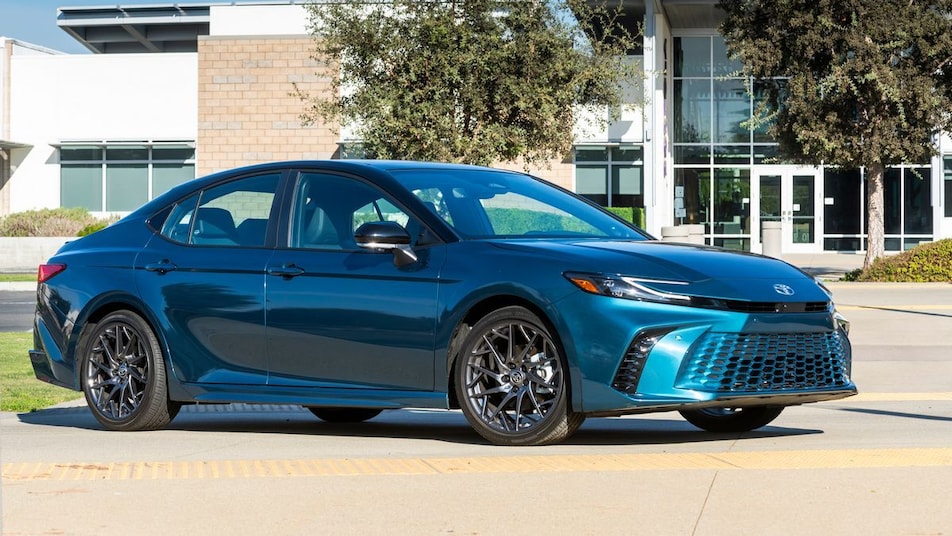
Used Toyota Camry Quick Facts
- The sweet spot for used Camry cars is actually two model-year groups: 2002-2006 and 2012-2017.
- The Toyota Camry first went on sale in 1982 as a 1983 model.
- For more than 20 years, the Camry has been America’s best-selling passenger car.
- Among midsize cars, the Camry retains the most value at five years.
The Camry has been a prominent part of Toyota’s lineup for more than 40 years. It hasn’t always been the flashiest or most exciting vehicle, but it has long offered an appealing combination of value, reliability, safety, and fuel economy. Now in its ninth generation, the Camry is hybrid-only. That combination helped Toyota sell more than 316,000 Camry sedans in 2025.
While it’s hard to go wrong with a used Camry, the car’s design and available features have changed considerably by generation. With so many generations and trims to choose from, finding the best Camry for your needs can be challenging. We’re here to help. This overview breaks down the specifications and notable features of the latest Camry generations, helping you identify the right car for your needs.
What Is the Best Model-Year Used Camry?
There aren’t many Camry model years we’d actively avoid, but two periods stand out most: 2002-2006 and 2012-2017. Models from these years have strong reputations for reliability, and they’re old enough to be reasonably priced. That said, you’ll need a 2018 or newer Camry for Apple CarPlay and a 2020 or newer model for Android Auto.
See used Toyota Camry cars near you.
Toyota Camry by Generation: Which Should You Buy?
The Camry has a long history. Here, we highlight the changes that differentiate each recent generation to help you choose a used example.
Ninth Generation (2025-Present)
The 2025 Toyota Camry is a hybrid-only midsize sedan offered in four trims: LE, SE, XLE, and XSE. Every 2025 Camry pairs a 2.5-liter four-cylinder gas engine with Toyota’s fifth-generation hybrid system for 225 net horsepower with front-wheel drive or 232 net horsepower with electronic on-demand all-wheel drive, all through an electronically controlled continuously variable transmission. Front-drive LE models are manufacturer-estimated at up to 53 mpg city, 50 mpg highway, and 51 mpg combined. All 2025 Camry trims share a 111.2-inch wheelbase, measure 193.5 inches long and 72.4 inches wide, seat five, and offer 15.1 cubic feet of trunk space. This table compares the hybrid powertrain, electric motors and battery, drivetrain, fuel economy, chassis, exterior and interior dimensions, wheels and tires, and weights across every 2025 Camry LE, SE, XLE, and XSE trim.
2025 Toyota Camry — Specifications by Trim
▼Note: The 2025 Toyota Camry is hybrid-only — every trim (LE, SE, XLE, and XSE) is a hybrid. There is no gas-only version for 2025.
| Specification | Toyota Camry | |||
|---|---|---|---|---|
| LE | SE | XLE | XSE | |
| Hybrid Powertrain | ||||
| Hybrid System Net Power | 225 hp (FWD) / 232 hp (AWD) | |||
| Engine | 2.5L I-4 DOHC 16-valve (2,487 cc) | |||
| Bore x Stroke | 3.44 x 4.07 in. | |||
| Compression Ratio | 14.0:1 | |||
| Engine Power (SAE net) | 184 hp @ 6,000 rpm | |||
| Engine Torque | 163 lb.-ft. @ 5,200 rpm | |||
| Recommended Fuel | 87 octane or higher, unleaded | |||
| Emission Rating | SULEV30 | |||
| Electric Motors & Battery | ||||
| Motor Type | Permanent-magnet synchronous | |||
| Front Motor Output | 100 kW / 208 N·m | |||
| Rear Motor Output (AWD) | 30 kW / 84 N·m | |||
| Hybrid Battery | Lithium-ion, 251.6 V (68 cells), 4.0 Ah | |||
| Drivetrain | ||||
| Transmission | Electronically controlled CVT (ECVT) | |||
| Drive | FWD standard; Electronic On-Demand AWD available | |||
| Fuel Economy — mfr-estimated, city / highway / combined | ||||
| MPG — FWD | 53 / 50 / 51 | 48 / 47 / 47 | 48 / 47 / 47 | 48 / 47 / 47 |
| MPG — AWD | 51 / 49 / 50 | 46 / 46 / 46 | 46 / 46 / 46 | 44 / 43 / 44 |
| Chassis | ||||
| Front Suspension | MacPherson strut with stabilizer bar | |||
| Rear Suspension | Multi-link with stabilizer bar; sport-tuned shocks & springs (SE, XSE) | |||
| Stabilizer Bar, front / rear (FWD) | 25.4 / 25.4 mm | 27.0 / 26.0 mm | 25.4 / 25.4 mm | 27.0 / 26.0 mm |
| Stabilizer Bar, front / rear (AWD) | 25.4 / 22.2 mm | 27.0 / 24.2 mm | 25.4 / 22.2 mm | 27.0 / 24.2 mm |
| Steering | Electric power rack-and-pinion (EPS) | |||
| Turning Circle (curb to curb) | 37.4 ft. | |||
| Front Brakes | 12.0-in. ventilated disc | |||
| Rear Brakes | 11.06-in. solid disc | |||
| Exterior Dimensions | ||||
| Wheelbase | 111.2 in. | |||
| Length | 193.5 in. | |||
| Width | 72.4 in. | |||
| Height | 56.9 in. | |||
| Track (front / rear) | 63.0 / 63.6 | 62.2 / 62.8 | 62.2 / 62.8 | 62.2 / 62.8 |
| Ground Clearance | 5.4 in. | |||
| Interior Dimensions | ||||
| Seating Capacity | 5 passengers | |||
| Head Room (front / rear) | 38.3 / 37.6 in. (37.5 / 37.6 w/ moonroof) | |||
| Leg Room (front / rear) | 42.1 / 38.0 in. | |||
| Shoulder Room (front / rear) | 57.7 / 55.7 in. | |||
| Hip Room (front / rear) | 55.4 / 54.6 in. | |||
| Passenger Volume (EPA) | 99.9 cu. ft. (98.8 w/ moonroof) | |||
| Cargo Volume (EPA) | 15.1 cu. ft. | |||
| Wheels & Tires — alloy wheels, all-season tires | ||||
| Wheels | 16 x 6.5 in. | 18 x 8 in. | 18 x 8 in. | 19 x 9 in. |
| Tires | P205/65R16 | P235/45R18 | P235/45R18 | P235/40R19 |
| Weights & Capacities | ||||
| Curb Weight — FWD | 3,450 lb. | 3,494 lb. | 3,516 lb. | 3,538 lb. |
| Curb Weight — AWD | 3,594 lb. | 3,627 lb. | 3,649 lb. | 3,682 lb. |
| Fuel Capacity | 13 gal. | |||
Source: 2025 Camry Product Information (Toyota). Specifications are for the 2025 model year and may vary with optional equipment. All 2025 Camry models are hybrids; front-wheel drive is standard and electronic on-demand all-wheel drive (which adds a dedicated rear electric motor) is available on every trim. Where a value spans all four grade columns, that specification is common to the listed 2025 Camry trims.
Hybrid system net power is 225-hp with front-wheel drive and 232-hp with all-wheel drive. Fuel-economy figures are Toyota manufacturer estimates for city/highway/combined driving and are provided for comparison only; actual mileage will vary. All listed wheels are alloy and all tires are all-season. The moonroof-equipped headroom, passenger-volume, and sport-tuned suspension figures apply to the trims noted.
Notable features of the 2025 Toyota Camry Hybrid compared across all four trims: LE, SE, XLE, and XSE. Highlights range from available electronic on-demand all-wheel drive, a power or panoramic moonroof, and a 12.3-inch digital gauge cluster to leather-trimmed and heated or ventilated front seats, a heated steering wheel, a 12.3-inch Toyota Audio Multimedia touchscreen, 9-speaker JBL Premium Audio, a 10-inch color Head-Up Display, wireless Apple CarPlay and Android Auto, Qi wireless charging, Toyota Safety Sense 3.0, Blind Spot Monitor with Rear Cross-Traffic Alert, and a Panoramic View Monitor. This table shows which features are standard, optional, packaged, or unavailable on each 2025 Camry LE, SE, XLE, and XSE trim.
2025 Toyota Camry — Notable Features by Trim
▼Note: The 2025 Toyota Camry is hybrid-only — every trim (LE, SE, XLE, and XSE) is a hybrid. There is no gas-only version for 2025.
S = Standard · O = Optional · P = Package · — = Not Available
| Feature | Toyota Camry | |||
|---|---|---|---|---|
| LE | SE | XLE | XSE | |
| Mechanical & Exterior | ||||
| Electronic On-Demand All-Wheel Drive | O | O | O | O |
| Dual LED projector headlights | — | — | S | S |
| Premium LED combination taillights | — | — | S | S |
| Power tilt/slide moonroof | O | O | — | — |
| Panoramic glass roof w/ power moonroof | — | — | P | P |
| Rain-sensing windshield wipers | — | — | P | — |
| Heated power mirrors w/ blind spot indicators | — | S | S | S |
| Two-tone exterior paint (black roof) | — | — | — | P |
| Interior & Comfort | ||||
| 12.3-in. fully digital gauge cluster | — | — | S | S |
| Leather-trimmed front seats | — | — | S | S |
| SofTex-trimmed sport front seats | — | S | — | — |
| 8-way power-adjustable driver’s seat | P | S | S | S |
| 8-way power-adjustable passenger seat | — | — | S | S |
| Driver’s seat memory function | — | — | P | — |
| Heated front seats | P | P | S | S |
| Heated & ventilated front seats | — | — | P | P |
| Leather-trimmed heated steering wheel | P | P | S | S |
| White LED ambient interior lighting | — | — | S | S |
| Auto-dimming mirror w/ HomeLink; Smart Key on front doors | P | P | S | S |
| Qi-compatible wireless charging | S | S | S | S |
| Multimedia & Audio | ||||
| 12.3-in. Toyota Audio Multimedia touchscreen | — | P | S | S |
| Wireless Apple CarPlay & Android Auto | S | S | S | S |
| 9-speaker JBL Premium Audio | — | — | P | P |
| 10-in. color Head-Up Display | — | — | P | P |
| Safety & Driver Assist | ||||
| Toyota Safety Sense 3.0 | S | S | S | S |
| Blind Spot Monitor w/ Rear Cross-Traffic Alert | S | S | S | S |
| Safe Exit Alert | S | S | S | S |
| Panoramic View Monitor (360-degree) | — | — | P | P |
| Front & Rear Parking Assist w/ Automatic Braking | — | — | P | P |
| Rear Cross-Traffic Braking | — | — | P | P |
| Lane Change Assist | — | — | P | P |
Source: 2025 Camry Product Information (Toyota). This is a curated set of notable, trim-differentiating features and not the complete equipment list. S = standard, O = optional, P = available as part of a package, and — = not available. Availability may change with production and region; confirm details with a dealer.
Several XLE and XSE highlights — such as the panoramic glass roof, 9-speaker JBL Premium Audio, ventilated front seats, 10-inch Head-Up Display, and the Panoramic View Monitor safety suite — are grouped into Premium or Premium Plus packages. All four 2025 Camry trims are hybrids and offer available electronic on-demand all-wheel drive.
Annual Updates
2026: New Nightshade trim with upgraded suspension and black styling elements.
2025: All-new ninth-generation Camry model.
RELATED: Legalities When Buying a Used Car From a Private Seller
See current Toyota Camry cars near you.
Eighth Generation (2018-2024)
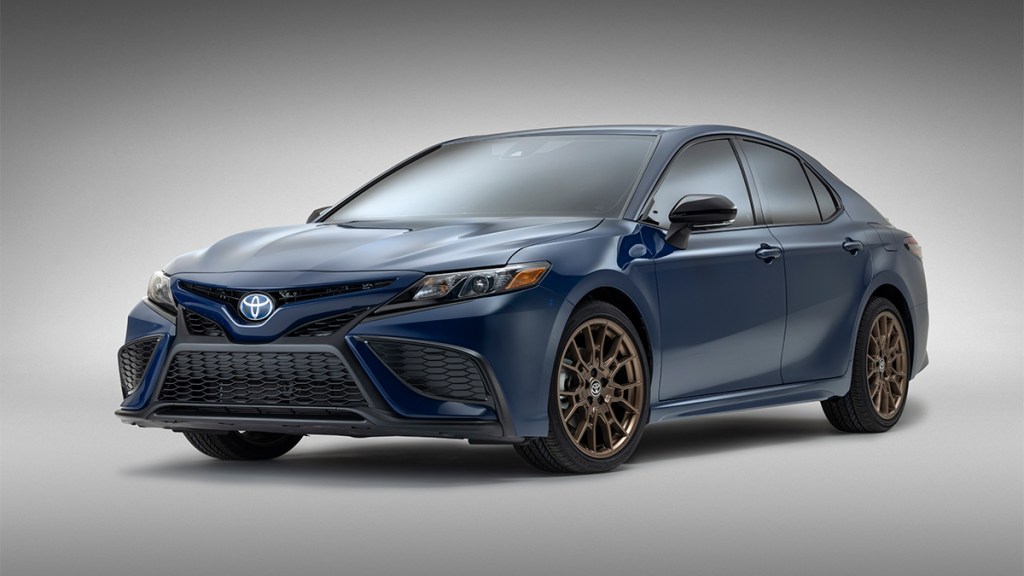
The 2024 Toyota Camry is a midsize sedan offered with three powertrains: a 2.5-liter four-cylinder gas engine making up to 206 horsepower, a 3.5-liter V6 gas engine making 301 horsepower, and a 2.5-liter gas-electric hybrid with 208 net horsepower. The 2.5-liter gas four-cylinder is available with front-wheel drive or all-wheel drive; the V6 and hybrid are front-wheel drive. Trims include LE, SE, SE Nightshade, XLE, XSE, and the V6-powered TRD. This specifications table compares engine, drivetrain, fuel economy, chassis, dimensions, wheels and tires, and weights across the 2024 Camry gas and hybrid models.
2024 Toyota Camry — Specifications by Powertrain
▼Note: The 2024 Toyota Camry is offered with three powertrains — a 2.5-liter gas four-cylinder, a 3.5-liter gas V6, and a 2.5-liter gas-electric hybrid. Figures below are grouped by powertrain; where trims differ, the trim is noted in the cell.
| Specification | Toyota Camry | ||
|---|---|---|---|
| 2.5L 4‑Cyl Gas | 3.5L V6 Gas | 2.5L Hybrid | |
| Engine | |||
| Configuration | 2.5L inline‑4 | 3.5L V6 | 2.5L inline‑4 + electric |
| Displacement | 2,487 cc | 3,456 cc | 2,487 cc |
| Bore x Stroke | 3.44 x 4.07 in. | 3.70 x 3.27 in. | 3.44 x 4.07 in. |
| Compression Ratio | 13.0:1 | 11.8:1 | 14.0:1 |
| Engine Horsepower | 202–206 hp @ 6,600 rpm | 301 hp @ 6,600 rpm | 176 hp @ 5,700 rpm |
| Engine Torque | 182–186 lb‑ft | 267 lb‑ft @ 4,700 rpm | 163 lb‑ft @ 5,200 rpm |
| Hybrid System Net Power | — | — | 208 hp |
| Electric Motor | — | — | Permanent-magnet synchronous, 88 kW (118 hp), 149 lb‑ft |
| Hybrid Battery | — | — | Lithium-ion, 259.0 V, 4.0 Ah |
| Recommended Fuel | 87-octane or higher unleaded | ||
| Drivetrain | |||
| Layout | FWD or AWD | Front-wheel drive | Front-wheel drive |
| Transmission | 8-speed Direct Shift automatic | 8-speed Direct Shift automatic | Electronically controlled CVT |
| Fuel Economy (EPA est. city / hwy / combined MPG) | |||
| LE | 28 / 39 / 32 (FWD) | — | 51 / 53 / 52 |
| SE / SE Nightshade | 28 / 39 / 32 (FWD) | — | 44 / 47 / 46 |
| XLE / XSE | 27 / 38 / 31 (FWD) | 22 / 33 / 26 (XLE) / 22 / 32 / 26 (XSE) | 44 / 47 / 46 |
| All-Wheel Drive | 25 / 34 / 28–29 | — | — |
| TRD | — | 22 / 31 / 25 | — |
| Chassis | |||
| Front Suspension | Independent MacPherson strut with stabilizer bar | ||
| Rear Suspension | Multi-link with stabilizer bar (sport-tuned on SE / XSE) | ||
| Steering | Electric power rack-and-pinion (EPS) | ||
| Front Brakes | Ventilated disc, 12.0 in. | Ventilated disc, 12.0–12.9 in. | Ventilated disc, 12.0 in. |
| Rear Brakes | Solid disc, 11.06 in. | ||
| Exterior Dimensions | |||
| Wheelbase | 111.2 in. | ||
| Overall Length | 192.1–192.7 in. | 192.1–194.6 in. (TRD) | 192.1–192.7 in. |
| Overall Width | 72.4 in. | 72.4–73.1 in. (TRD) | 72.4 in. |
| Overall Height | 56.9–57.1 in. | 56.3–56.9 in. | 56.9 in. |
| Ground Clearance | 5.7 in. | ||
| Interior Dimensions | |||
| Seating Capacity | 5 | ||
| Headroom (Front / Rear) | 38.3 / 38.0 in. (37.5 in. front w/ moonroof) | ||
| Legroom (Front / Rear) | 42.1 / 38.0 in. | ||
| Shoulder Room (Front / Rear) | 57.7 / 55.7 in. | ||
| Hip Room (Front / Rear) | 55.4 / 54.6–54.7 in. | ||
| EPA Passenger Volume | 100.4 cu. ft. | 100.4 cu. ft. | 99.9 cu. ft. |
| EPA Cargo Volume | 15.1 cu. ft. | ||
| Wheels & Tires | |||
| Wheel Sizes | 17 in. (LE), 18 in. (SE / SE NS / XLE), 19 in. (XSE) | 18 in. (XLE), 19 in. (XSE), 19 x 8.5 in. (TRD) | 16 in. (LE), 18 in. (SE / SE NS / XLE), 19 in. (XSE) |
| Wheel Material | Alloy | Alloy | Steel (LE); alloy (others) |
| Tire Sizes | P215/55R17, P235/45R18, P235/40R19 | P235/45R18, P235/40R19 | P205/65R16, P235/45R18, P235/40R19 |
| Tire Type | All-season | All-season (summer opt. on TRD) | All-season |
| Weights & Capacities | |||
| Curb Weight | 3,310–3,580 lbs. | 3,575–3,595 lbs. | 3,480–3,580 lbs. |
| Fuel Capacity | 15.8 gal. (FWD) / 14.4 gal. (AWD) | 15.8 gal. | 13.2 gal. |
| Maximum Towing | Not rated for towing | ||
Source: 2024 Camry and 2024 Camry Hybrid Product Information (Toyota). Specifications are for the 2024 model year and may vary with trim, drivetrain, and optional equipment. The 2.5-liter gas four-cylinder is available with front-wheel drive or electronic on-demand all-wheel drive; the 3.5-liter V6 and the 2.5-liter hybrid are front-wheel drive. The TRD is a V6-only performance trim.
Fuel-economy figures are EPA/manufacturer estimates for city/highway/combined driving and are provided for comparison only; actual mileage will vary. Where a value spans all three powertrain columns, that specification is common to the listed 2024 Camry models.
Notable features of the 2024 Toyota Camry compared across six trims: LE, SE, SE Nightshade, XLE, XSE, and TRD. Highlights range from available electronic on-demand all-wheel drive, a panoramic glass roof, leather-trimmed and heated or ventilated front seats, and a heated steering wheel to a 9-inch Audio Plus touchscreen, 9-speaker JBL Premium Audio, a 10-inch color Head-Up Display, Toyota Safety Sense 2.5+, Blind Spot Monitor with Rear Cross-Traffic Alert, and a Bird’s Eye View camera. Feature availability is shared between the gas and hybrid versions of each trim; the TRD is a V6-only performance grade. This table shows which features are standard, optional, packaged, or unavailable on each 2024 Camry trim.
2024 Toyota Camry — Notable Features by Trim
▼Note: Availability shown applies to both the gas and hybrid versions of each trim (LE, SE, SE Nightshade, XLE, XSE). The TRD is a V6-only, gas performance grade; the hybrid is front-wheel drive only.
S = Standard · O = Optional · P = Package · — = Not Available
| Feature | Toyota Camry | |||||
|---|---|---|---|---|---|---|
| LE | SE | SE NS | XLE | XSE | TRD | |
| Mechanical & Exterior | ||||||
| Electronic On-Demand All-Wheel Drive (2.5L gas) | O | O | O | O | O | — |
| Bi-LED combination headlights | S | S | S | — | — | S |
| Full LED headlights w/ integrated LED DRLs | — | — | — | S | S | — |
| Power tilt/slide moonroof | O | O | — | — | — | — |
| Panoramic glass roof w/ power moonroof | — | — | — | O | O | — |
| Two-tone black roof & rear spoiler | — | — | — | — | O | O |
| Heated power mirrors w/ turn signal & blind spot indicators | P | P | — | S | S | S |
| TRD aero kit, sport spoiler & cat-back dual exhaust | — | — | — | — | — | S |
| Interior & Comfort | ||||||
| Dual-zone automatic climate control w/ rear-seat vents | P | P | — | S | S | — |
| Qi-compatible wireless charging | P | P | — | S | S | — |
| Leather-trimmed front seats | — | — | — | S | S | — |
| Sport SofTex-trimmed front seats | — | S | S | — | — | S |
| 8-way power-adjustable front passenger seat | — | — | — | S | S | — |
| Multi-stage heated front seats | P | P | — | S | S | — |
| Multi-stage heated & ventilated front seats | — | — | — | P | P | — |
| Heated steering wheel | — | P | — | P | P | — |
| 7-in. TFT Multi-Information Display | — | — | — | S | S | — |
| Ambient interior lighting | — | — | — | S | S | — |
| Smart Key on front doors & trunk w/ Push Button Start | P | P | P | S | S | S |
| Auto-dimming rearview mirror | P | P | P | S | S | — |
| Multimedia & Audio | ||||||
| 7-in. touchscreen audio (6 speakers) | S | S | S | — | — | S |
| 9-in. Audio Plus touchscreen | O | O | — | S | S | — |
| 9-speaker JBL Premium Audio | — | — | — | P | P | P |
| 10-in. color Head-Up Display | — | — | — | P | P | — |
| Wired Apple CarPlay & Android Auto | S | S | S | S | S | S |
| Safety & Driver Assist | ||||||
| Toyota Safety Sense 2.5+ | S | S | S | S | S | S |
| Full-Speed Range Dynamic Radar Cruise Control | — | — | — | S | S | S |
| Blind Spot Monitor w/ Rear Cross-Traffic Alert | O | O | O | S | S | S |
| Bird’s Eye View Camera w/ Perimeter Scan | — | — | — | P | P | — |
| Intelligent Clearance Sonar w/ Rear Cross-Traffic Braking | — | — | — | P | P | — |
Source: 2024 Camry and 2024 Camry Hybrid Product Information (Toyota). This is a curated set of notable, trim-differentiating features and not the complete equipment list. S = standard, O = optional, P = available as part of a package, and — = not available. Availability may change with production and region; confirm details with a dealer.
Availability shown applies to both the gas and hybrid versions of the LE, SE, SE Nightshade, XLE, and XSE. The TRD is a V6-only, gas performance grade and is not offered as a hybrid. Several XLE and XSE highlights — such as the panoramic glass roof, JBL Premium Audio, ventilated front seats, 10-inch Head-Up Display, and Bird’s Eye View camera — are grouped into option packages.
Annual Updates
2024: Mostly a carryover model, but Toyota cut Amazon Alexa functionality.
2023: New optional SE Nightshade package, additional advanced driver-assistance tech.
2022: Nightshade package becomes available for Camry Hybrid models, new color options.
2021: Base L model discontinued, revised exterior design, new infotainment touchscreens and driver-assistance features.
2020: TRD Camry model debuts with lowered suspension and upgraded brakes, handling, and exhaust.
2019: Standard Apple CarPlay, more tech features, and a new infotainment display for XLE and XSE trims.
2018: All-new eighth-generation model.
See 2018-2024 Toyota Camry cars near you
Seventh Generation (2012-2017)
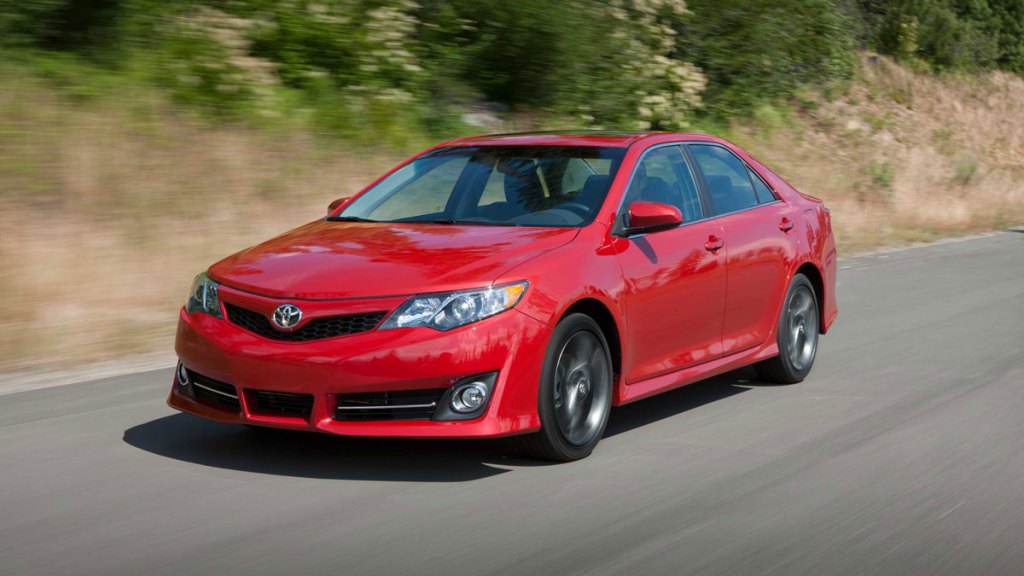
The 2017 Toyota Camry is a midsize sedan offered with three powertrains: a 2.5-liter four-cylinder gas engine making 178 horsepower, a 3.5-liter V6 gas engine making 268 horsepower, and a 2.5-liter gas-electric hybrid with 200 net horsepower. All 2017 Camry models are front-wheel drive. Trims include LE, SE, XSE, and XLE. This specifications table compares engine, drivetrain, fuel economy, chassis, dimensions, wheels and tires, and weights across the 2017 Camry gas and hybrid models.
2017 Toyota Camry — Specifications by Powertrain
▼Note: The 2017 Toyota Camry is offered with three powertrains — a 2.5-liter gas four-cylinder, a 3.5-liter gas V6, and a 2.5-liter gas-electric hybrid — all front-wheel drive. Figures below are grouped by powertrain; where trims differ, the trim is noted in the cell.
| Specification | Toyota Camry | ||
|---|---|---|---|
| 2.5L 4‑Cyl Gas | 3.5L V6 Gas | 2.5L Hybrid | |
| Engine | |||
| Configuration | 2.5L inline‑4 | 3.5L V6 | 2.5L inline‑4 + electric |
| Displacement | 2,494 cc | 3,456 cc | 2,494 cc |
| Bore x Stroke | 3.54 x 3.86 in. | 3.70 x 3.27 in. | 3.54 x 3.86 in. |
| Compression Ratio | 10.4:1 | 10.8:1 | 12.5:1 |
| Engine Horsepower | 178 hp @ 6,000 rpm | 268 hp @ 6,200 rpm | 156 hp @ 5,700 rpm |
| Engine Torque | 170 lb‑ft @ 4,100 rpm | 248 lb‑ft @ 4,700 rpm | 156 lb‑ft @ 4,500 rpm |
| Hybrid System Net Power | — | — | 200 hp |
| Electric Motor | — | — | Permanent-magnet AC synchronous, 105 kW, 199 lb‑ft |
| Hybrid Battery | — | — | Sealed nickel-metal hydride, 244.8 V, 6.5 Ah |
| Recommended Fuel | 87-octane or higher unleaded | ||
| Emission Certification | ULEV-II | ULEV-II | AT-PZEV |
| Drivetrain | |||
| Layout | Front-wheel drive | ||
| Transmission | 6-speed ECT-i automatic | 6-speed ECT-i automatic | Electronically controlled CVT |
| Fuel Economy (EPA est. city / hwy / combined MPG) | |||
| LE | 24 / 33 / 27 | — | 42 / 38 / 40 |
| SE / XSE / XLE | 24 / 33 / 27 | 21 / 30 / 24 | 40 / 37 / 38 |
| Chassis | |||
| Front Suspension | Independent MacPherson strut with stabilizer bar | ||
| Rear Suspension | Independent dual link with stabilizer bar (sport-tuned on SE / XSE) | ||
| Steering | Electric power rack-and-pinion (EPS), 14.8:1 | ||
| Front Brakes | Ventilated disc, 11.65 in. | ||
| Rear Brakes | Solid disc, 11.0 in. | Solid disc, 11.0 in. | Solid disc, 11.06 in. |
| Turning Circle | 36.7 ft. (curb to curb) | ||
| Exterior Dimensions | |||
| Wheelbase | 109.3 in. | ||
| Overall Length | 190.9 in. | ||
| Overall Width | 71.7 in. | ||
| Overall Height | 57.9 in. | ||
| Ground Clearance | 6.1 in. | ||
| Coefficient of Drag | 0.28 | 0.28 | 0.27 |
| Interior Dimensions | |||
| Seating Capacity | 5 | ||
| Headroom (Front / Rear) | 38.8 / 38.1 in. (37.9 / 38.0 in. w/ moonroof) | ||
| Legroom (Front / Rear) | 41.6 / 38.9 in. | ||
| Shoulder Room (Front / Rear) | 58.0 / 56.6 in. | ||
| Hip Room (Front / Rear) | 54.5 / 54.5 in. | ||
| EPA Passenger Volume | 102.7 cu. ft. (101.3 cu. ft. w/ moonroof) | ||
| EPA Cargo Volume | 15.4 cu. ft. | 15.4 cu. ft. | 13.1 cu. ft. |
| Wheels & Tires | |||
| Wheel Sizes | 16 in. (LE), 17 in. (SE / XLE), 18 in. (XSE) | 17 in. (XLE), 18 in. (XSE) | 16 in. (LE), 17 in. (SE / XLE) |
| Wheel Material | Steel (LE); alloy (others) | Alloy | Steel (LE); alloy (others) |
| Tire Sizes | P205/65R16, P215/55R17, P225/45R18 | P215/55R17, P225/45R18 | P205/65R16, P215/55R17 |
| Tire Type | All-season | ||
| Weights & Capacities | |||
| Curb Weight | 3,245–3,350 lbs. | 3,460–3,480 lbs. | 3,485–3,585 lbs. |
| Fuel Capacity | 17 gal. | ||
| Maximum Towing | Not rated for towing | ||
Source: 2017 Camry and 2017 Camry Hybrid Product Information (Toyota). Specifications are for the 2017 model year and may vary with trim and optional equipment. Every 2017 Camry is front-wheel drive; the 3.5-liter V6 is offered on the XSE and XLE, and the hybrid is offered in LE, SE, and XLE trims.
Fuel-economy figures are EPA/manufacturer estimates for city/highway/combined driving and are provided for comparison only; actual mileage will vary. Where a value spans all three powertrain columns, that specification is common to the listed 2017 Camry models.
Notable features of the 2017 Toyota Camry compared across four trims: LE, SE, XSE, and XLE. Highlights range from a sport-tuned suspension, LED daytime running lights, a power tilt/slide moonroof, and leather-trimmed or heated front seats to Qi wireless charging, a Smart Key with Push Button Start, Entune Premium JBL audio with navigation, Blind Spot Monitor with Rear Cross-Traffic Alert, and the available Technology Package with Pre-Collision System and Dynamic Radar Cruise Control. Feature availability is shared between the gas and hybrid versions of each trim; the XSE is offered only as a gas model. This table shows which features are standard, optional, packaged, or unavailable on each 2017 Camry trim.
2017 Toyota Camry — Notable Features by Trim
▼Note: Availability shown reflects the gas trims and applies closely to the hybrid LE, SE, and XLE. The hybrid LE adds a Smart Key with Push Button Start and dual-zone automatic climate control as standard, and the XSE is offered only as a gas model.
S = Standard · O = Optional · P = Package · — = Not Available
| Feature | Toyota Camry | |||
|---|---|---|---|---|
| LE | SE | XSE | XLE | |
| Mechanical & Exterior | ||||
| Sport-tuned suspension | — | S | S | — |
| LED Daytime Running Lights | — | — | S | S |
| Color-keyed rear spoiler | — | S | S | — |
| 17-in. alloy wheels | — | S | — | S |
| 18-in. machined alloy wheels | — | — | S | — |
| Power tilt/slide moonroof | O | O | O | O |
| Chrome-tipped exhaust (dual on V6) | — | S | S | — |
| Interior & Comfort | ||||
| Dual-zone automatic climate control w/ rear-seat vents | — | — | S | S |
| Sport SofTex-trimmed front seats | — | S | — | — |
| Sport leather & Ultrasuede front seats | — | — | S | — |
| Leather-trimmed front seats | — | — | — | S |
| Multi-stage heated front seats | — | — | S | S |
| Qi-compatible wireless charging | — | O | S | S |
| Smart Key System w/ Push Button Start | — | P | P | S |
| Auto-dimming rearview mirror w/ compass | — | P | S | S |
| Leather-trimmed steering wheel | — | S | S | S |
| Multimedia & Audio | ||||
| Entune Audio (6.1-in. touchscreen, 6 speakers) | S | S | — | — |
| Entune Audio Plus w/ Connected Navigation (7-in.) | O | S | — | — |
| Entune Premium JBL Audio w/ Navigation (10 speakers) | — | O | S | S |
| Integrated backup camera | S | S | S | S |
| Safety & Driver Assist | ||||
| Star Safety System (VSC, TRAC, ABS, EBD, BA, SST) | S | S | S | S |
| 10 airbags | S | S | S | S |
| Blind Spot Monitor w/ Rear Cross-Traffic Alert | — | — | S | S |
| Technology Package (PCS, DRCC, LDA, Auto High Beam) | — | — | O | O |
| Safety Connect (emergency assistance) | — | — | — | O |
Source: 2017 Camry and 2017 Camry Hybrid Product Information (Toyota). This is a curated set of notable, trim-differentiating features and not the complete equipment list. S = standard, O = optional, P = available as part of a package, and — = not available. Availability may change with production and region; confirm details with a dealer.
Availability shown reflects the gas trims and applies closely to the hybrid LE, SE, and XLE; the hybrid LE adds a Smart Key with Push Button Start and dual-zone automatic climate control as standard. The XSE is offered only as a gas model. Several XSE and XLE highlights — such as the moonroof, Smart Key, and the Technology Package — are grouped into option or convenience packages.
Annual Updates
2017: No changes for final year of the generation.
2016: New Special Edition trim, updated Entune Audio with navigation.
2015: Refreshed styling, new XSE and Hybrid SE trims.
2014: Standard rearview camera, next-generation Entune infotainment system.
2013: Infotainment display screen becomes standard, new interior materials for LE and SE trims.
2012: All-new seventh-generation model.
See 2012-2017 Toyota Camry cars near you.
The Older Years
Is the Toyota Camry a Good Car?
The Camry is an easy car to recommend. It’s not the most exciting vehicle on the road, but Toyota has offered powerful V6 engine options, and the Camry’s styling has become sportier and more aggressive in recent years. Although some model years have had notable issues, most Camry generations offer strong reliability, and Toyota does a good job of packaging desirable features into its trim levels.
Toyota has sold millions of cars over the years, so used-car shoppers have plenty of choices. Parts are generally very easy to find and more affordable than those for lower-volume models. The Camry is also a leader in value retention, holding its pricing better than many competitors in its segment.
The Camry has earned top safety ratings for many years. The Insurance Institute for Highway Safety (IIHS) has given the car a Top Safety Pick+ or Top Safety Pick designation every year since 2012, a strong record of safety that can provide peace of mind.
How Much Is a Used Toyota Camry?
There are currently more than 18,000 used examples nationwide on Autotrader. Prices range from $575 on the low end to more than $52,000 for a nearly new 2026 certified pre-owned Camry. While the lowest prices might seem tempting, the cheapest examples often have extremely high mileage, some have unrepaired collision damage, or undiagnosed mechanical problems.
How Long Does a Camry Last?
With proper care, it’s not uncommon for a Camry to reach 200,000 miles or more. Achieving that kind of mileage requires regular maintenance, including oil and filter changes, tire rotations, and other services recommended by the manufacturer. Toyota backs its hybrid models with a 10-year/150,000-mile warranty on the electric drivetrain components.
RELATED: Buying a Used Car: What Does ‘As Is’ Mean?
What Are the Most Reliable Years for a Toyota Camry?
Despite a known transmission issue experienced by some owners, we like the fifth-generation Camry models from 2002 to 2006 because they are remarkably affordable. When carefully maintained, these models can run for hundreds of thousands of miles. They are also comfortable and fairly well-equipped for their age.
What Are the Worst Years for the Toyota Camry?
We’re not sure there’s a Camry model year to avoid entirely. If forced to make such a pick, we’d probably steer clear of sixth-generation models, particularly those from 2007-2009. These were the Camry’s most troublesome years.
Should You Buy a Used Toyota Camry?
If you’re in the market for a reliable, value-oriented sedan, the answer is yes. Few cars match the Camry for its combination of reliability, safety features, comfort, and fuel economy. However, as with any used car, we recommend getting an independent pre-purchase inspection. Spending a little on a thorough inspection could save you thousands in unexpected repairs down the road.
Editor’s Note: We have updated this article since its initial publication.


I have a used 1994 Toyota Camry with over 340,000 the odometer does not work. I’ve been running it over two years and it still runs good and gets me to where I need to go. Am very happy with my Toyota.