


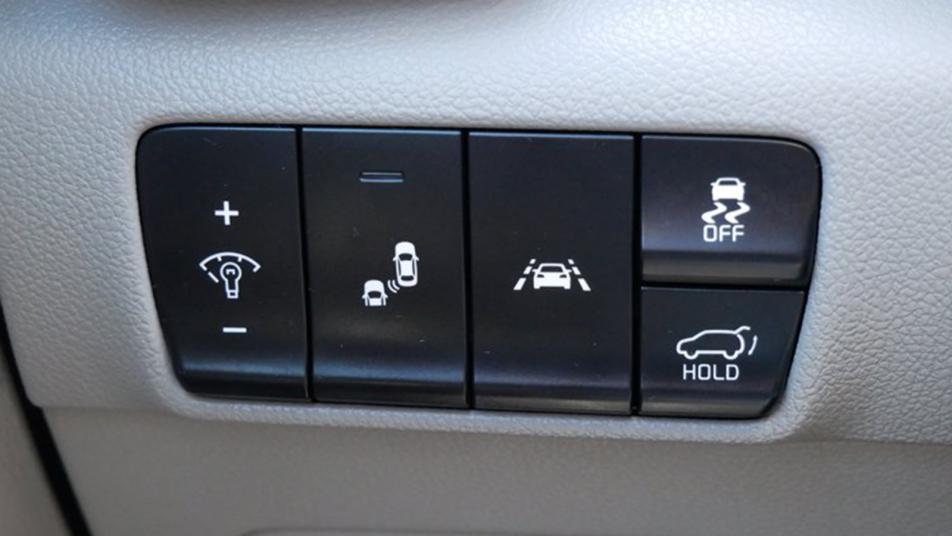
Don’t sacrifice vital safety features when shopping for a new or used car — even if you’re trying to stay on budget. We get it: prices are high, and most shoppers are looking for smart ways to save, whether that means buying certified pre-owned, choosing a smaller vehicle, or stepping down a trim level. The good news is you can still shop affordably while prioritizing the safety features that matter most.
Below are eight features worth seeking out, listed in a practical order: major crash-prevention and occupant-protection features first, then visibility and convenience tech.
- Forward Collision Warning and Prevention
- Stability Control
- Side Curtain Airbags
- Traction Control
- Rear Parking Camera
- Rear Cross-Traffic Alert
- Head-up Display
- Engine Immobilizer
1. Forward Collision Warning and Prevention
Forward collision warning alerts you if you’re closing in too quickly on a vehicle ahead. Forward collision prevention takes it further by applying the brakes to help avoid a crash — or reduce the severity of an impact. This is often marketed as automatic emergency braking.
The feature is especially helpful in stop-and-go traffic, on busy roads, and in low-speed situations where attention can slip for a moment.
What to look for: “Forward collision warning,” “automatic emergency braking,” “AEB,” “front assist,” or “pre-collision system.” Ideally, the listing specifies both warning and braking — some cars only have the alert.
2. Stability Control
Stability control (often called electronic stability control) helps prevent skids and spin-outs. If the car starts to slide or rotate, it can brake individual wheels and reduce engine power to help keep the vehicle on its intended path.
Some older used cars may have traction control but not stability control — so it’s worth confirming, especially on older models.
What to look for: “Stability control,” “electronic stability control,” or “ESC.” Some brands call it “VSC,” “DSC,” “StabiliTrak,” or “ESP.” If you’re looking at an older used car, confirm it has stability control — not just ABS and traction control.
3. Side Curtain Airbags
Front airbags are a minimum expectation, but side curtain airbags are a major safety upgrade — especially for head protection in side impacts and rollovers. Not all older vehicles have them, so don’t assume they’re included just because a listing says “airbags.”
Frontal airbags have been required in new passenger vehicles since the 1999 model year. Side curtain airbags aren’t always specifically required, but they’re a smart feature to prioritize — particularly for teen drivers.
What to look for: “Side curtain airbags,” “curtain airbags,” “head-protecting airbags,” or “side impact airbags.” If the listing only says “airbags,” ask for details — some vehicles have only front airbags. A quick visual clue is “SRS Curtain Airbag” labeling near the roofline/B-pillar area, but always verify via the window sticker or build sheet when possible.
4. Traction Control
Traction control helps keep your wheels from slipping on wet or icy roads, as well as on snow, sand, or other low-grip surfaces. It can cut engine power and/or apply braking automatically to help the tires regain traction — especially when accelerating.
What to look for: “Traction control,” “TCS,” or “TRAC.” In many cars, you’ll see a dash button that can reduce/disable it (helpful in certain snow situations), but you generally want traction control available and functioning.
5. Rear Parking Camera
If you’re an experienced driver, you can live without a rear camera — especially in a smaller car. But if you’re buying a car for a teenager (or a driver who regularly parks in tight spots), don’t skip it. A rear camera can prevent backing accidents and costly mistakes.
If you frequently park in very tight spaces, consider a 360-degree system for a full view around the car.
What to look for: On listings and window stickers, search for “rearview camera,” “backup camera,” “rear camera,” or “parking camera.” If you want the upgraded view, look for “360 camera,” “surround-view camera,” “bird’s-eye view,” or “top-down camera.”
6. Rear Cross-Traffic Alert
Rear cross-traffic alert is a parking-lot lifesaver. It warns you when a vehicle or pedestrian is moving behind your car from either side — especially when you’re backing out between larger vehicles and can’t see around them.
It’s a great companion to a rear camera and parking sensors, but it’s useful even on its own.
What to look for: “Rear cross-traffic alert,” “cross-traffic warning,” or “RCTA.” Some brands bundle it inside driver-assist packages, so also check packages labeled “Safety Sense,” “Driver Assist,” “Advanced Safety,” or similar.
7. Head-up Display
A head-up display (HUD) keeps key information in your line of sight — like speed, speed limit, and navigation prompts — so you spend less time glancing down. It can be especially helpful for teens, but it’s a nice safety boost for any driver.
Aftermarket HUDs are also an option if the vehicle doesn’t come with one.
What to look for: “Head-up display,” “HUD,” or “projected display.” If you’re shopping used, confirm it’s actually installed and not just available on higher trims. Test it at night and in daylight for brightness and readability.
8. Engine Immobilizer
An engine immobilizer is an anti-theft feature that prevents the car from starting without an authorized key or fob. It uses a coded chip that must match what the vehicle expects before the engine will run.
This is common on many vehicles, but not guaranteed — especially on older cars and base trims — so it’s worth verifying before you buy.
What to look for: “Engine immobilizer,” “anti-theft immobilizer,” “transponder key,” or “chip key.” Also ask how many keys come with the car — replacing programmed keys/fobs can be expensive, and some vehicles require dealer programming.
Bottom Line
Shopping on a budget is smart, but don’t “save” by skipping the features that can prevent a crash or reduce injuries. Decide which safety items are non-negotiable, then narrow your search to models and trims that include them. If a listing is vague, ask for the window sticker or build sheet — because “it has airbags” or “driver-assist” doesn’t always mean it has the specific protection you want.

Quick List to Save Before You Shop
- Forward collision warning + braking: “FCW” + “AEB” / “automatic emergency braking” / “pre-collision”
- Stability control: “ESC” / “stability control” / “ESP” / “VSC” / “DSC” / “StabiliTrak”
- Side curtain airbags: “side curtain/curtain airbags” / “head-protecting airbags” (don’t accept vague “airbags”)
- Traction control: “traction control” / “TCS” / “TRAC”
- Rear parking camera: “rearview/backup camera” (bonus: “360/surround-view”)
- Rear cross-traffic alert: “rear cross-traffic alert” / “RCTA” / “cross-traffic warning”
- Head-up display: “HUD” / “head-up display” / “projected display”
- Engine immobilizer: “engine immobilizer” / “transponder key” / “chip key” (ask how many keys are included)
Editor’s Note: We have updated this article since its initial publication.


This article is informative, well-crafted, and highly valuable. I particularly appreciate the inclusion of the “Rear Parking Camera” feature, as it is one of my personal favorites.
Forward collision warning and prevention has been very valuable. I was driving cross country in the Texas Hill country when a deer suddenly ran into my path. Instantly, before I could react, my vehicle applied the brakes and avoided disaster. Blind Spot notification on the side rear view mirrors is another safety must have.
Would it not be much more simple to have these safety features as standard equipment across the entire auto manufacturing industry?
To answer Bonnie Miller’s comment, the HUD keeps attention focused on what the vehicle is approaching and allows for more rapid response time compared to taking one’s attention away from what the driver is approaching. Much like that of a jet aircraft. I agree with Bonnie on the location of the HUD is some cases. Another feature manufacturers should standardize in the vehicles as well as location of the HUD projection.
I especially like the idea of the rear cross-traffic alert because I think parking lots are where a lot of accidents occur, not necessarily very dangerous to the drive, but for pedestrians and minor car body damage.
It would have been helpful to offer a listing of which manufacturers offer features on the list, and whether they are standard or optional. Also, do insurers offer discounts if your vehicle has these safety features? That would be of major interest, I think, because let’s face it, these features don’t come cheap, and most are not ‘standard’.
That’s why it’s so important to be familiar with trim levels when buying a used car. Not all used cars have the same features base on if it’s an SE, XL, RS, or whatever.
Great article! Interestingly I read an article last week that said manufacturers were considering “dumbing down” new vehicles because all of the new features were adding too much cost to new cars; but, safety features such as those in the above article would be well worth the added cost.
And the good news is, as a used car, those features don’t add that much cost.
Interesting article. Read another article a week or so ago that manufacturers were considering offering more new vehicles with less new features because many drivers didn’t understand them and could not use them. Safety features like those in this article are well worth taking the time to understand and use. I will certainly look for safety features on my next vehicle.
I wish that when the car suddenly decides to alert me by buzzing, beeping, etc it would show a display of whiat it thinks is the reason. And why suddenly stop my car on the freeway? Don’t they think this is a cause for alarm?
You might need to visit the dealer if you’re experiencing malfunctioning like that.
Good artical will look for these on my next buy
thanks
Yeah I’m really liking this Knowledge Center
I am not a huge fan of all of the features. I enjoy driving and some things to me like the back up camera can be both distracting as well as helpful. I also do not like when you are in traffic and the car will stop on its own.
Traction control is a must for my next car now
I like all the safety features you have listed but feel some are more important than others. The blind spot indicator is very important to me as is the adaptive cruise control. I don’t like the head up display because I feel it can be too distracting.
Good advice. All the added tech, however, is one reason almost any crash can “total” a car rather quickly. All those airbags and machinery to replace gets costly.
You hit the nail on the head. Increasing amount of tech for all these features is putting a strain on buyers.
Yes, true. A older car with airbags depoyed will likely be deemed a “total loss.” However, that’s better than loss of life or serious injury.
How great are new cars!!
I like all the 8 safety features. they are innovative
These safety features are a game changer. I really like rear cross traffic warning and forward collision warning and prevention.
I like all of the suggestions except the Head-Up Display. I’ve used it and I agree with Bonnie Miller that it’s a little distracting and appears to be unsafe.
While I can see how looking away from the windshield is dangerous when driving, I don’t see how running a bunch of information across my line of sight on the windshield is any safer. In fact, if that information is always in my line of sight, I think that would be less safe.