


Buying a certified pre-owned (CPO) vehicle allows car shoppers to get the best of both worlds: Cost savings of a used car and the safety net of a warranty. However, many buyers don’t realize that CPO programs are not standardized across manufacturers. Every manufacturer sets its own rules, warranty lengths, and perks.
If you’re considering buying a vehicle from multiple manufacturers, you’ll want to look past the “Certified Pre-Owned” label and compare the details. Here’s a short guide on what to look for when evaluating and comparing CPO programs side-by-side.
1. Manufacturer CPO vs. Dealer-Certified
Something that can be confusing for new buyers is the difference between a manufacturer’s CPO program and a dealer-certified car. Always go for a manufacturer-backed CPO program.
- Manufacturer-Backed: Most importantly, the warranty is honored at any of the manufacturer’s franchised dealerships. If you buy a manufacturer CPO Ford in California, a Ford dealer in New York will honor the warranty.
- Dealer-Certified: These are independent programs run by specific dealerships. This means that the warranty is only good at that specific location, or sometimes within a small network of partner stores. The quality of the inspection relies entirely on that individual service department.
2. Learn About Different Warranty Types
Don’t just look at the headline numbers like “100,000-mile warranty”. You’ll want to look closely at how that coverage is calculated and what the warranty covers.
Powertrain vs. Bumper-to-Bumper
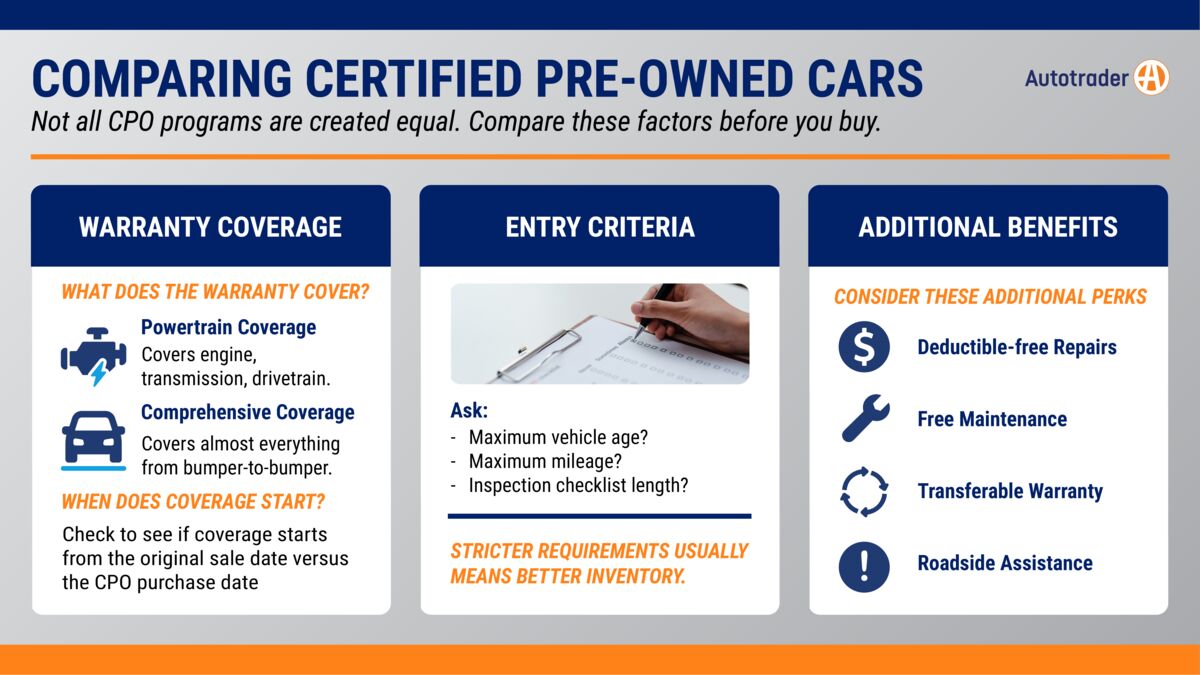
- Powertrain Coverage: Covers the powertrain components, which are usually the most expensive. This includes anything related to the engine, transmission, or drivetrain.
- Comprehensive (Bumper-to-Bumper): Covers almost everything else, like air conditioning, infotainment systems, electrical components, and suspension.
From New vs. From Purchase
Look at how the expiration date is measured:
- From Original In-Service Date: If a program offers a “6-year/100,000-mile warranty from the original in-service date,” and you buy a 3-year-old car with 35,000 miles on it, you’d only have 3 years or 65,000 miles left on your warranty.
- From CPO Purchase Date: This is a much more generous policy. The CPO warranty starts from the date you purchase the vehicle, rather than the original date the vehicle was first purchased.
- Consider CPO Entry Criteria: A CPO program is only as good as the inventory it allows in. If a manufacturer allows older, high-mileage vehicles into its program, the associated risks are higher. If you’re deciding between multiple manufacturers, we recommend comparing the entry criteria. You’ll want to look for things like mileage, model year, and inspection.
Visit Autotrader’s CPO page to learn more about individual manufacturer programs.
3. Evaluate Additional Perks
When prices and warranty lengths are identical, the tie-breaker comes down to additional complimentary ownership perks. Here are some things you may want to check for:
- Deductibles: Do you have to pay a $50 or $100 deductible every time you bring the car in for a warranty repair?
- Complimentary Maintenance: Some programs include a couple of years of scheduled oil changes and tire rotations at no extra cost.
- Transferability: If you sell the car in a few years, can the remaining CPO warranty transfer to the next buyer?
Visit Autotrader’s Car Buying Information Center for curated articles and other resources to help you go into your car deal with confidence.


