


If you’re considering buying a new or used car, you may have noticed that some models come with xenon or LED headlights instead of traditional halogen bulbs. Halogen headlights were once the standard across most vehicles, but many automakers are now shifting to brighter, more efficient lighting options. So what exactly are xenon and LED headlights, and how do they differ?
What Is a Xenon Headlight?
A xenon headlight, also known as a high-intensity discharge (HID) light, is a gas-filled bulb that delivers a very bright bluish-white light. One reason for xenon lights’ increasing popularity is their extreme brightness and stylish glow. Xenon/HID systems are often much brighter than halogen and may be brighter than some LED setups, depending on the headlamp design.
Although xenon lights may seem more practical, they come with a trade-off. HID lights typically draw more power than LEDs and generally don’t last as long as LEDs.
Pros of Xenon Headlights
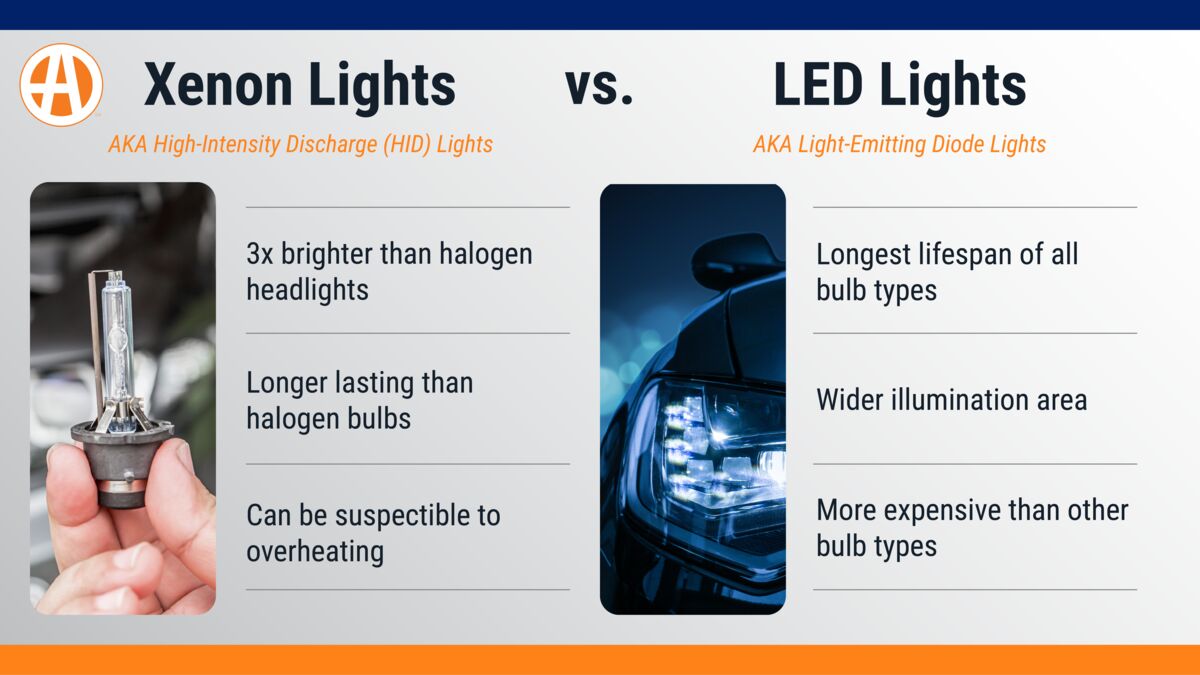
- Xenon bulbs are two to three times brighter than halogen bulbs.
- Greater illumination from xenon headlights also adds a stylish look.
- Xenon headlights typically last longer than halogen lights.
Cons of Xenon Headlights
- Upgrading to xenon headlamps means higher repair and replacement costs.
- The lifespan of xenon lights is shorter than that of LED headlights.
- HID/xenon bulbs use a ballast to regulate power, which can make them susceptible to overheating.
What Is an LED Headlight?
A light-emitting diode (LED) headlight is a durable, bright, and energy-efficient light for your car. LED headlights have quickly become a favorite among drivers and manufacturers for their practicality. LEDs last longer than halogen and xenon bulbs, which means lower long-term maintenance costs. Multiple individual diodes are packed into one headlight unit, giving better overall illumination of the road. They are easier to install than xenon, and LEDs can be tuned to different color temperatures, but road-legal headlights are generally limited to regulated colors.
The LED headlights are more expensive than xenon upfront, but the cost may even out over time with the savings from their longevity.
Pros of LED Headlights
- LED headlights illuminate a wider area than other types.
- LED lights have a longer lifespan than xenon bulbs.
- Replacement is straightforward, but could require replacing the entire unit.
Cons of LED Headlights
- High upfront costs.
- Glare from LED headlights can be painfully evident to oncoming traffic.
Xenon vs. LED: Which Is Best?
If you’re looking for the best possible illumination, LEDs often outshine their xenon headlight rivals. Brightness depends on the number of LEDs and the overall headlight design. Still, most modern cars with LED lighting offer better illumination, a warmer light, and a larger illuminated area than vehicles with xenon lights.
However, xenon headlights aren’t exactly low on light. In most popular cars using xenons today, overall illumination falls just short of LEDs. And while LEDs will last longer than xenons, both will last for many years, likely longer than many drivers will own their vehicles.
Regarding safety, both headlight variants outshine halogen units, which makes them safer. Many vehicles of both types offer high-beam assist, which automatically activates the high beams in dark areas. Many vehicles offer features like automatic high beams and adaptive/curving headlights, regardless of whether the lighting is LED or HID.
Insurance Institute for Highway Safety (IIHS) headlight ratings depend on performance (visibility and glare), not the technology, though many newer high-rated systems are LEDs.
According to the IIHS, nearly half of traffic deaths occur in the dark. Since LED lights illuminate better, some drivers might choose them because they can see farther down the road.
Which Headlight Should You Get? LED or Xenon?
If you can buy a car with LED headlights at roughly the same price as a model with xenon lights, we suggest going for the LEDs.
LED headlights provide excellent illumination and last longer than others. But if the cost is dramatically more than a car equipped with xenon headlights, we’d go with the latter. That’s because xenon headlights are far superior to halogen lights. LEDs are becoming cheaper to make, so you can expect to see them in a broader range of vehicles.
Editor’s Note: We have updated this article since its initial publication.


I am looking for the BRIGHTEST LED possible (retrofitting a 16mm projector). How do I go about finding the LED replacement bulb for a car that would out-shine all the others…in other words, the brightest LED bulb on the market. I won’t have any problem getting a power-supply for whatever bulb I can come up with. I just need to find an off-the-shelf LED bulb that I can substitute for the existing incandescent in the projector. There is plenty of space; I am just looking for the brightest thing out there.
Be aware that some vehicles will not work correctly with led lights for example :- my X type rear lights have a combined bulb IE. brakes and rear lights on one double filament bulb. I bought led double bulbs and fitted them, when I put the lights on all of the led,s on both bulbs lit up at once leaving me without brake lights !!! I asked at “Halfords ” where I bought them and they told me some cars wont accept led, they were kind enough to offer me my money back.
If your car came with halogen lights stock, you can easily switch them out for LED bulbs. They’re about $30-$50 a pair online. Simplest car mod, ever.
Thanks for the info. Concise and informative, if only all articles could be this way.
very useful information.