


Here’s the secret about tires: In many respects, no other single vehicle component is as critical to your car’s functions. Tires play a role in safety, fuel economy, handling, ride quality, noise, and other aspects of your car’s operation. They even impact the function of the electric system’s motors, batteries, and range limits.
Choosing tires for your hybrid electric vehicle (HEV), plug-in hybrid electric vehicle (PHEV), or electric vehicle (EV) should be done correctly and carefully. EVs tend to weigh more due the the heavy battery packs. As a result, the vehicles require special EV tires that are graded for higher loads.
But fear not: We’ll cover the important aspects of electric-based vehicle tire replacement and walk you through what you need to know when picking the best replacement tire for your HEV, PHEV, or EV.
- How Tires Affect Your EV’s Driving Personality
- Why Tires Matter for Electric Vehicles
- What to Look for in HEV, PHEV, and EV Tires
- Shopping for EV, Hybrid, and PHEV Tires
How Tires Affect Your Driving
Whether you drive a Nissan Leaf, a Jeep Wrangler, a Toyota Camry, an Acura NSX, or any other electrified vehicle, the tires you choose will contribute heavily to your overall experience. You may or may not have thought much about the tires when you bought your hybrid, plug-in hybrid, or electric vehicle , but you will eventually need to replace them.
Like other products, tires widely range in price since they address varying needs. Different balances of polymers in a tire’s compound, tread design, and other factors alter a tire’s core purpose.
They can be manufactured for different purposes such as for snow, off-roading, performance, or fuel economy. A snow tire will have increased traction compared to regular tires, but increased traction comes with softer rubber, meaning that they’ll wear out faster. If you want to reduce road noise, your tires can make a difference there as well. Other characteristics that tires may improve are steering feel, braking distance, fuel economy, and overall ride quality.
Why Tires Matter
Tires serve the same function for electric-based and ICE vehicles alike, though it’s not a one-size-fits-all situation. Different tires will have different results. However, there are some specific characteristics of electric-based vehicles beyond those of typical internal combustion engine (ICE) vehicles that tires must address.
We reached out to Dale Harrigle, the chief engineer for replacement tire development at Bridgestone Americas, for his take. Bridgestone provides the original equipment (OE) tires for the BMW i3, Mercedes-Benz EQS, and Fisker Ocean.
“Heavier loads and higher torque mean that the tire has to work harder,” he explained. “There’s more twist and more weight, which affect tire wear life. Many (EV) cars are whisper quiet, which results in greater consideration of tire noise and general NVH (noise, vibration, harshness).” He also mentioned that a tire’s rolling resistance plays an essential role in the total efficiency and the range per charge or fueling of a vehicle — EV or otherwise.
The Four Unique Characteristics Influencing Tire Design for EVs and Hybrids

1. Extra Weight
PHEVs or EVs typically weigh from 450 to 1,600 pounds more than their gas-powered siblings.
2. Higher Torque Loads
The torque for a PHEV or an EV is applied the instant you engage the throttle. Many HEV systems also kick into action with initial throttle engagement, adding a burst of torque.
3. Quiet
EVs are quiet without the chaos of an ICE and all the moving mechanical parts associated with it. When running in electric-only mode, PHEVs are eerily quiet, as well. Because of that lack of mechanical racket, every other sound like wind or road noise is much more apparent.
4. Limited Range
The truth is that batteries run out of juice. So, you want to squeeze out every mile of range promised by the manufacturer. This battery issue affects the electric-only range in PHEVs and the overall range in EVs. In pure hybrids (HEVs), you can think of “range” as fuel economy.
What to Look for in HEV, PHEV, and EV Tires
Again, there is no one-size-fits-all when considering new tires for your EV or hybrid. Granted, replacing tires on an HEV is less problematic than for a PHEV or EV, but many of the same issues apply. Each driver will find themselves with different needs.
Is your end goal for new tires to give your car a personality adjustment by making it quieter, sportier, extra fuel-efficient, or comfier? In that case, the best course is to buy the same original equipment (OE) tires that came on the vehicle when it was new. Often the OE tires are a product of the carmaker and tire company working together to develop the ideal tire for that specific model. These are tires engineered to maximize the experience the carmaker intended and advertised.
If you decide to embark on a new tire quest, don’t necessarily expect to find your tire dealer’s shelves brimming with tires with “EV” stamped on the sidewall. Some tire manufacturers are making products specifically labeled as being for EVs, while others don’t have specific EV-labeled products. Despite this, they may still have tires that are well suited to EVs despite being marketed under traditional product names.
Research is your friend. Do the work. As you make your way through all the possibilities, consider the four EV- and hybrid-specific issues you must address: weight, torque, quiet, and range.
Shopping for EV, Hybrid, and PHEV Tires
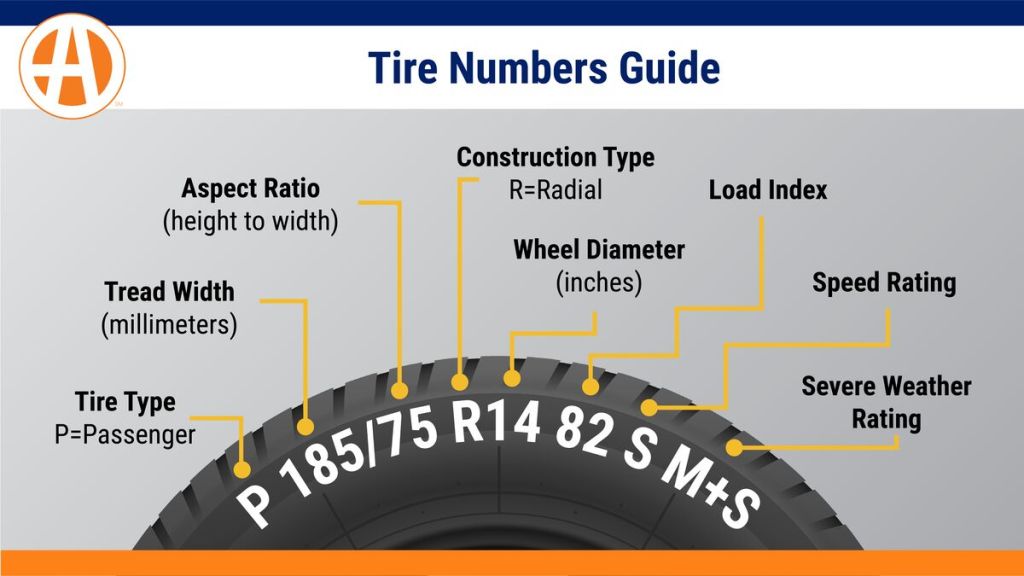
You should know a few terms if you’ve decided to veer from the OE tires.
Tire Load Index for EVs
Because weight is a key factor when finding a replacement tire, you need to know your vehicle’s GVWR (gross vehicle weight rating). This rating is roughly the maximum weight your tires will bear, including the car, passengers, cargo, and fuel (if the vehicle uses gas). For example, a Kia EV6 all-electric SUV’s GVWR is 5,004 pounds. When shopping for four replacement tires, the Tire Load Index must be more than 1,250 pounds or one-fourth of the GVWR.
How to Find the Tire Load Index
A tire’s Tire Load Index is included among the information on a tire’s sidewall. For instance, if you study a tire’s sidewall, you will see numbers like 245/45RF20. These numbers identify the tire’s size, followed by a double- or triple-digit number and a letter: 245/45RF20 99Y. The 99 is the Tire Load Index. The numbers run from 70 (739 pounds) to 126 (3,748 pounds). Our 99 example is 1,709 pounds.
Although intuitively, you would think you can divide the GVWR by four to arrive at the weight each tire must support, there’s a bit more to it. That’s because each pair of tires is on a separate axle. Remember, the distribution of a vehicle’s weight is uneven. One axle will almost always support more of the vehicle’s weight. Therefore, the wheels on that axle will be handling more of the load. Adding 10% to 15% to each tire’s load requirement will provide sufficient cushion.
Adjusting the EV6’s GVWR by 15% totals 5,754. When you divide this number by four, it works out to a Tire Index Load number of 93 (1,433) or higher. Your car’s GVWR rating is on a label affixed to the driver’s door frame. You can see the full range of Tire Load Index ratings here.
Rolling Resistance
Rolling resistance has everything to do with maximizing your vehicle’s range. The less rolling resistance the tires create, the less energy the electric motor(s) must produce to spin the wheels. Reducing the motor energy required means pulling less stored electricity from the battery. This reduction results in maximizing the range. Even with an HEV, less rolling resistance will increase fuel economy and vehicle range.
Although tires are not living things, they often react like one. As tires roll along the ground, they transfer the vehicle’s weight around its circumference. The 2 or 3 inches of a tire in contact with the pavement and the corresponding sidewall sections bear most of the load at any given moment. Consequently, tires are in a constant state of compression and recovery. The friction caused by the tire tread engaging the surface determines a tire’s rolling resistance. Size enters into it, as well. Larger tires provide more rolling resistance than smaller ones, primarily due to the added tire weight.
Tire makers can influence rolling resistance through shallower treads, stiffer (harder) rubber compounds, and other factors. A standardized equation determines rating a tire’s rolling resistance. However, the issue for shoppers is that the government hasn’t mandated the inclusion of rolling resistance ratings in a tire’s sidewall information.
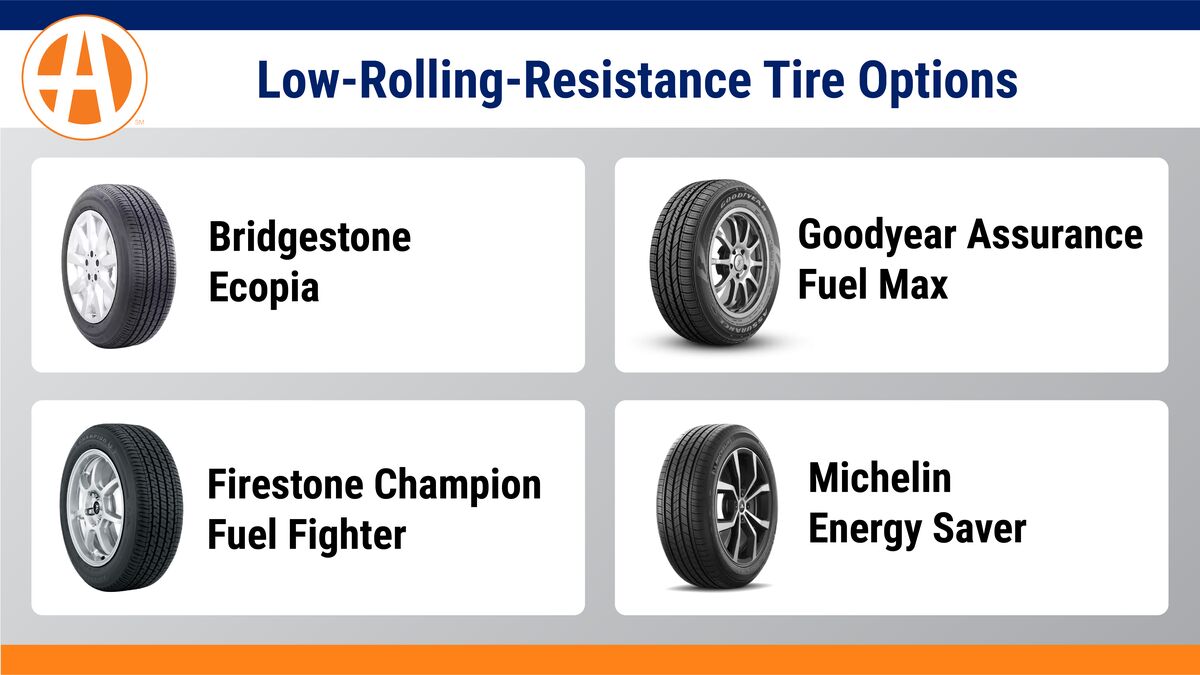
Virtually every passenger-vehicle tire maker has at least one low-rolling-resistance product line. Here are a few of them:
- Bridgestone Ecopia
- Goodyear Assurance Fuel Max
- Firestone Champion Fuel Fighter
- Michelin Energy Saver
Sustainability
In owning an electric or hybrid car, you demonstrate a passion for minimizing your environmental footprint. That is to say, you have a certain amount of concern for sustaining natural resources. That means you want to buy tires engineered to last. But how do you know how long they will last?
A best guess can be made by finding out how many miles are covered in the tire’s manufacturer’s warranty. But it is also important to analyze where and how you drive your vehicle. Road surfaces, temperatures, and city-versus-highway driving impact a tire’s longevity.
Among the information on a tire’s sidewall is a treadwear rating. In theory, the higher the rating, the longer a tire will last, but it’s all relative. The treadwear rating doesn’t correspond to a specific number of miles. Moreover, the individual tire makers arrive at those treadwear ratings themselves. A 600 treadwear rating at one manufacturer doesn’t necessarily equal a 600 rating at another. The government mandates that these ratings appear on every tire, but they don’t mean much.
Editor’s note: This article has been updated since its original publication. Russ Heaps contributed to this report.
Read Related Articles:
- Run-Flat Tires: Advantages and Drawbacks
- Electric Cars, Hybrids, and Weather: What You Need to Know
- Plug-In Hybrid Buying Guide
See all the Electric Cars, PHEVs, and Hybrids available to buy today.


Thank you! A very informative article! PH/EV a totally new ballgame and helping tire dealers understand differences is critical!
Thank you, Bob, for reading. We like getting your comments. Did you have a particular experience with EV tires that you care to share?