


Used Ford Mustang Quick Facts
- The 2020 to 2024 Mustang offers the best bang for your buck, especially the V8-powered GT trim.
- In continuous production since 1964, Ford has sold over 10 million Mustang models.
- With 815 horsepower, the 2025 Mustang GTD is the most powerful Mustang to date.
If you asked the average person to name the most iconic American car, there’s a good chance the Ford Mustang would come up. Once locked in an existential battle with other heavyweight American cars like the Chevrolet Camero and Dodge Challenger, the Ford Mustang stands as the only V8-powered coupe available from a U.S. automaker today. Newer models offer several advanced tech and driver-assistance features, but there are performance-heavy cars available from all of the Mustang’s seven generations.
If you’re in the market for a used Ford Mustang, the car’s long history and extensive model range can make it difficult to pick just one, but we’re here to help. This overview covers all Mustang generations to date, their notable features, and key updates they’ve received over the years. Let’s dive in.
What Is the Best Model-Year Used Ford Mustang?
There have been so many iconic Mustang models over the years that it’s almost impossible to choose just one as the best, but we have a few ideas.
If you’re looking for strong performance and modern tech at a lower price than a new Mustang, the models from the 2020 through 2023 model years can offer great value, depending on the mileage and condition. They feature significant updates over the previous generation cars, and you’ll have access to special models, such as the Mach 1 and GT500.
While Ford now offers a turbocharged 4-cylinder engine in the Mustang EcoBoost, we still prefer the current V8 and earlier V6 engines. They provide a more engaging sound than the 4-cylinder and have fewer well-known issues.
If your budget is a bit tighter, there’s nothing wrong with a fifth-generation Mustang from 2011 or newer. Ford improved the car’s drivetrain durability, and later models received revised styling.
Finally, any V8 Mustang from the third generation can be a great choice for shoppers on a budget. These cars, also known as “Fox Body” Mustangs, have smaller, lighter bodies, blocky 1970s and ’80s styling, and widespread aftermarket support for performance upgrades.
See Ford Mustang models for sale near you.
Ford Mustang by Generation: Which Should You Buy?
Seventh Generation: 2024-Current
The 2025 Ford Mustang (S650 generation) is a rear-wheel-drive sports car offered in three powertrain families: the EcoBoost uses a 315-horsepower 2.3-liter turbocharged EcoBoost four-cylinder; the GT uses a 5.0-liter Ti-VCT V8 rated at 480 horsepower (486 horsepower with the active-valve exhaust); and the Dark Horse uses a high-output 5.0-liter Ti-VCT V8 producing 500 horsepower. The EcoBoost is automatic-only with a 10-speed transmission, while the GT and Dark Horse come standard with a six-speed manual (a Getrag MT-82 for the GT and a TREMEC TR-3160 for the Dark Horse) and offer the 10-speed automatic. This specifications table compares engine, drivetrain, EPA fuel economy, chassis, brakes, wheels and tires, exterior and interior dimensions, and capacities across the 2025 Mustang EcoBoost, GT, and Dark Horse.
2025 Ford Mustang — Specifications by Model
▼Note: Figures below are grouped by model. The EcoBoost column also covers EcoBoost Premium, and the GT column also covers GT Premium (both share the same engine and chassis). Exterior, interior, and capacity dimensions are for the fastback coupe; the convertible and Dark Horse (coupe-only) may vary slightly.
| Specification | Ford Mustang | ||
|---|---|---|---|
| EcoBoost 2.3L | GT 5.0L | Dark Horse 5.0L HO | |
| Engine | |||
| Configuration | 2.3L turbocharged DOHC I‑4 | 5.0L Ti‑VCT DOHC V8 | 5.0L high-output Ti‑VCT DOHC V8 |
| Valvetrain | DOHC, Ti‑VCT | ||
| Displacement | 137.5 cu. in. (2,300 cc) | 307 cu. in. (5,038 cc) | 307 cu. in. (5,038 cc) |
| Bore x Stroke | 3.30 x 4.0 in. | 3.63 x 3.65 in. | 3.63 x 3.65 in. |
| Compression Ratio | 10.6:1 | 12.0:1 | 12.0:1 |
| Induction | Twin-scroll turbo with overboost | Naturally aspirated (dual air boxes & throttle bodies) | Naturally aspirated (dual air boxes & throttle bodies) |
| Horsepower | 315 hp @ 5,500 rpm | 480 hp @ 7,150 rpm 486 hp w/ active-valve exhaust | 500 hp @ 7,250 rpm |
| Torque | 350 lb‑ft @ 3,000 rpm | 415 lb‑ft @ 4,900 rpm 418 lb‑ft w/ active-valve exhaust | 418 lb‑ft @ 4,900 rpm |
| Recommended Fuel | Regular unleaded | Premium (recommended) | Premium (recommended) |
| Drivetrain | |||
| Drive Layout | Rear-wheel drive with limited-slip differential | ||
| Standard Transmission | 10-speed automatic | Getrag MT‑82 6-speed manual w/ rev-matching | TREMEC TR‑3160 6-speed manual w/ rev-matching |
| Available Transmission | — (automatic only) | 10-speed SelectShift automatic | 10-speed SelectShift automatic |
| Final Drive Ratio | 3.15:1 (3.55:1 LSD w/ Perf. Pkg) | 3.15:1 LSD (3.55/3.73 TORSEN w/ Perf. Pkg) | 3.55:1 auto / 3.73:1 manual, TORSEN |
| Rear Differential | Limited-slip | Limited-slip (TORSEN w/ Perf. Pkg) | TORSEN limited-slip |
| Fuel Economy (EPA est. city / hwy / combined mpg; fastback) | |||
| Manual | — | 15 / 23 / 18 | 14 / 22 / 17 |
| Automatic | 22 / 33 / 26 | 16 / 24 / 19 | 14 / 22 / 17 |
| Chassis & Brakes | |||
| Front Suspension | Double-ball-joint MacPherson strut with stabilizer bar and aluminum control arms | ||
| Rear Suspension | Integral-link independent with coil springs and stabilizer bar | ||
| Adaptive Dampers (MagneRide) | Optional (Perf. Pkg) | Optional (Perf. Pkg) | Standard |
| Steering | Selectable-effort electric power-assisted (EPAS), 15.5:1 ratio | ||
| Brakes | Four-wheel power disc with electronic parking brake, ABS & AdvanceTrac stability control | ||
| Front Brakes | 320 x 30 mm vented, twin-piston (390 mm Brembo 6-piston opt.) | 352 x 32 mm vented, 4-piston (390 mm Brembo 6-piston opt.) | 390 x 36 mm vented two-piece, Brembo 6-piston |
| Electronic Drift Brake | Performance Package | Performance Package | Standard |
| Wheels & Tires | |||
| Standard Wheels & Tires | 17″ x 7.5″, 235/55R all-season | 18″ x 8.5″, 255/45R all-season | 19″ (9.5″ fr / 10″ rr), 255/40R fr & 275/40R rr summer |
| Available Wheels & Tires | Up to 19″ x 9.0″ 255/40R summer (Perf. Pkg) | Up to 19″ (9″ fr / 9.5″ rr) 255/40R fr & 275/40R rr summer (Perf. Pkg) | Handling Pkg: 19″ (10.5″ fr / 11″ rr), 305/30R fr & 315/30R rr summer |
| Exterior Dimensions (fastback) | |||
| Wheelbase | 107.0 in. | ||
| Overall Length | 189.4 in. | 189.4 in. | 189.7 in. |
| Overall Width (excl. mirrors) | 75.4 in. | 75.4 in. | 75.5 in. |
| Overall Width (incl. mirrors) | 81.9 in. | ||
| Overall Height | 55.0 in. | 55.0 in. | 55.2 in. |
| Track Width (Front / Rear) | 62.0 / 64.7 in. | 62.0 / 64.7 in. | 62.2 / 63.9 in. |
| Est. Curb Weight | 3,588 lb | 3,827–3,832 lb | 3,949–3,993 lb |
| Interior Dimensions (fastback) | |||
| Seating Capacity | 4 | ||
| Head Room (Front) | 37.6 in. | ||
| Shoulder Room (Front) | 56.3 in. | ||
| Leg Room (Front) | 44.5 in. | ||
| Head Room (Rear) | 34.8 in. | ||
| Shoulder Room (Rear) | 52.2 in. | ||
| Leg Room (Rear) | 29.0 in. | ||
| Capacities (fastback) | |||
| Passenger Volume | 82.8 cu. ft. | ||
| Trunk Volume | 13.3 cu. ft. | ||
| Fuel Capacity | 16.0 gal. | ||
Specifications are for the 2025 model year and may vary with model, body style, transmission, and optional equipment. The EcoBoost column also represents EcoBoost Premium and the GT column also represents GT Premium, as each pair shares the same engine and chassis. Exterior, interior, and capacity dimensions shown are for the fastback coupe; the EcoBoost and GT are also offered as convertibles, while the Dark Horse is coupe-only.
The GT is rated at 480 horsepower / 415 lb-ft, rising to 486 horsepower / 418 lb-ft with the available active-valve performance exhaust. Fuel-economy figures are EPA estimates for city/highway/combined driving and are provided for comparison only; actual mileage will vary. Curb weights are manufacturer estimates and range by transmission.
Notable features of the 2025 Ford Mustang compared across six trims: EcoBoost, EcoBoost Premium, GT, GT Premium, Dark Horse, and Dark Horse Premium. Highlights range from a standard six-speed manual with rev-matching (GT and Dark Horse), six selectable drive modes, LED headlamps, FordPass Connect with 4G LTE Wi-Fi, SYNC 4 with a 13.2-inch touchscreen, a 12.4-inch digital instrument cluster, Track Apps, and the Ford Co-Pilot360 suite of driver-assist safety features to available B&O premium audio, RECARO sport seats, MagneRide adaptive suspension, Brembo six-piston front brakes, an electronic drift brake, and the active-valve performance exhaust. The track-focused Dark Horse adds standard MagneRide, standard Brembo brakes, a TORSEN limited-slip differential, and a standard drift brake. This table shows which features are standard, optional, or packaged on each 2025 Mustang trim.
2025 Ford Mustang — Notable Features by Trim
▼Note: The Dark Horse is a track-focused, coupe-only model. Many performance and comfort items are grouped into option packages — for example the Performance Package, Handling Package, and the Premium equipment groups. The EcoBoost is offered only with the 10-speed automatic; the GT and Dark Horse are standard with a six-speed manual.
S = Standard · O = Optional · P = Package · — = Not Available
| Feature | Ford Mustang | |||||
|---|---|---|---|---|---|---|
| EcoBoost | EcoBoost Prem. | GT | GT Prem. | Dark Horse | D. Horse Prem. | |
| Mechanical & Performance | ||||||
| 6-speed manual transmission | — | — | S | S | S | S |
| 10-speed automatic transmission | S | S | O | O | O | O |
| Rev-matching & no-lift shift (manual) | — | — | S | S | S | S |
| Limited-slip rear differential | S | S | S | S | S | S |
| TORSEN limited-slip differential | P | P | P | P | S | S |
| MagneRide adaptive suspension | P | P | P | P | S | S |
| Brembo 6-piston front brakes | P | P | P | P | S | S |
| Electronic drift brake | P | P | P | P | S | S |
| Active-valve performance exhaust | — | — | O | O | S | S |
| Six selectable drive modes | S | S | S | S | S | S |
| Line lock & launch control | S | S | S | S | S | S |
| Exterior | ||||||
| LED headlamps, DRL & auto high-beam | S | S | S | S | S | S |
| Rain-sensing wipers | S | S | S | S | S | S |
| Rear decklid spoiler | S | S | S | S | S | S |
| Dark Horse-specific styling (grille / fascia) | — | — | — | — | S | S |
| Hood / racing stripes | O | O | O | O | O | O |
| Heated sideview mirrors | S | S | S | S | S | S |
| Convertible body style available | S | S | S | S | — | — |
| Interior & Comfort | ||||||
| SYNC 4 w/ 13.2″ touchscreen | S | S | S | S | S | S |
| 12.4″ configurable digital cluster | S | S | S | S | S | S |
| Apple CarPlay & Android Auto | S | S | S | S | S | S |
| Leather-trimmed seats | — | S | — | S | — | S |
| RECARO sport seats | — | — | — | O | O | O |
| Heated & cooled front seats | — | O | — | O | — | O |
| Heated steering wheel | — | O | — | O | — | O |
| Dual-zone electronic auto climate control | S | S | S | S | S | S |
| Ambient interior lighting | — | O | — | O | — | O |
| Wireless charging pad | — | O | — | O | — | O |
| Technology & Infotainment | ||||||
| FordPass Connect 4G LTE Wi-Fi | S | S | S | S | S | S |
| Track Apps performance suite | S | S | S | S | S | S |
| SiriusXM w/ Traffic & Travel Link | — | S | — | S | — | S |
| B&O premium audio (12-speaker) | — | O | — | O | — | O |
| Voice-Activated Navigation System | O | O | O | O | O | O |
| Safety & Security | ||||||
| Ford Co-Pilot360 (Pre-Collision Assist, BLIS, Lane-Keeping) | S | S | S | S | S | S |
| Rear View Camera | S | S | S | S | S | S |
| Intelligent Adaptive Cruise (Stop-and-Go) | O | O | O | O | O | O |
| Front, side, knee & side-curtain airbags | S | S | S | S | S | S |
| AdvanceTrac electronic stability control | S | S | S | S | S | S |
| Electronic parking brake | S | S | S | S | S | S |
| Tire Pressure Monitoring System | S | S | S | S | S | S |
| MyKey & anti-theft system | S | S | S | S | S | S |
S = Standard, O = Optional, P = Package, — = Not Available. This is a curated set of notable and differentiating features for the 2025 model year, not the complete factory equipment matrix. Availability may vary with body style, transmission, equipment group, and standalone options.
Several items are grouped into option packages: MagneRide adaptive dampers, Brembo six-piston front brakes, the TORSEN limited-slip differential, and the electronic drift brake arrive via the Performance Package on the EcoBoost and GT and are standard on the Dark Horse; heated/cooled seats, ambient lighting, wireless charging, and B&O audio are bundled into the Premium equipment groups. The EcoBoost column also represents EcoBoost Premium mechanicals and the GT column also represents GT Premium mechanicals.
Model-Year Changes
2026: New Dark Horse SC model debuts with a supercharged V8, along with a new FX appearance package.
2025: Mustang anniversary edition debuts with retro gauge cluster and unique styling elements.
2024: All-new seventh-generation Mustang debuts.
See 2024-to-current Ford Mustang models for sale near you
Sixth Generation: 2015-2023
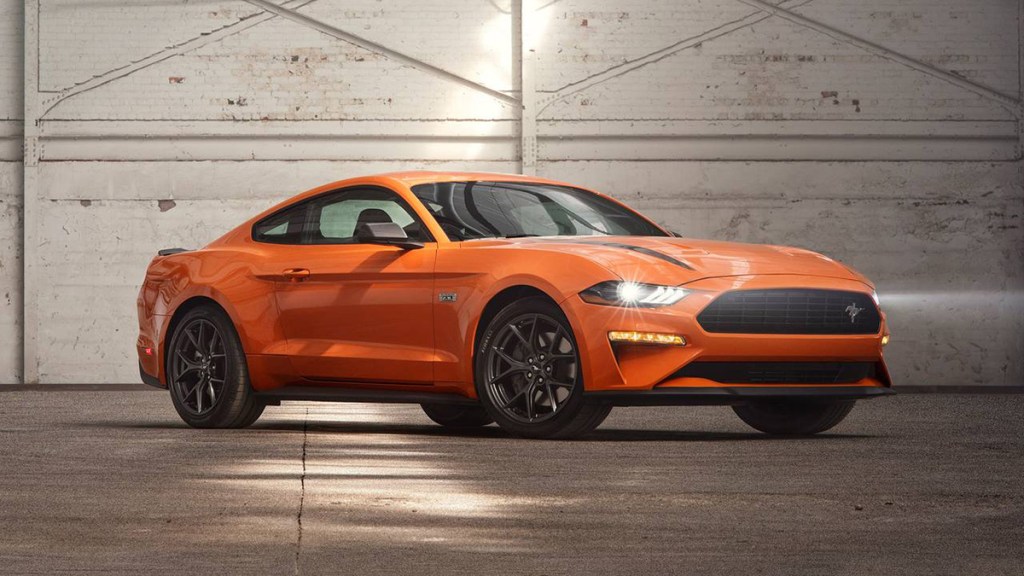
The 2021 Ford Mustang is a rear-wheel-drive sports car offered in four powertrain families: the EcoBoost uses a 310-horsepower 2.3-liter turbocharged EcoBoost four-cylinder (330 horsepower with the 2.3L High Performance Package); the GT uses a 460-horsepower 5.0-liter Ti-VCT V8; the Mach 1 uses a 480-horsepower high-output 5.0-liter V8; and the Shelby GT500 uses a supercharged 5.2-liter cross-plane-crank V8 producing 760 horsepower and 625 lb-ft of torque. The EcoBoost, GT, and Mach 1 come standard with a six-speed manual and offer a 10-speed SelectShift automatic, while the Shelby GT500 uses a 7-speed dual-clutch automatic exclusively. This specifications table compares engine, drivetrain, EPA fuel economy, chassis, brakes, wheels and tires, exterior and interior dimensions, and capacities across the 2021 Mustang EcoBoost, GT, Mach 1, and Shelby GT500.
2021 Ford Mustang — Specifications by Model
▼Note: Figures below are grouped by model. The EcoBoost column also covers EcoBoost Premium, and the GT column also covers GT Premium (both share the same engine and chassis). Exterior, interior, and capacity dimensions are published figures for the fastback body style; the convertible and models with unique aero (Mach 1, Shelby GT500) may vary slightly.
| Specification | Ford Mustang | |||
|---|---|---|---|---|
| EcoBoost 2.3L | GT 5.0L | Mach 1 5.0L HO | Shelby GT500 5.2L SC | |
| Engine | ||||
| Configuration | 2.3L turbocharged DOHC I‑4, aluminum | 5.0L Ti‑VCT DOHC V8 | 5.0L high-output Ti‑VCT DOHC V8 | 5.2L cross-plane-crank DOHC V8, supercharged |
| Valvetrain | DOHC, Ti‑VCT (16-valve) | DOHC, Ti‑VCT (32-valve) | DOHC, Ti‑VCT (32-valve) | DOHC (32-valve) |
| Induction | Turbocharged & intercooled | Naturally aspirated | Naturally aspirated (Open Air Induction) | Supercharged & intercooled (2.65L Eaton) |
| Horsepower | 310 hp @ 5,500 rpm 330 hp w/ 2.3L HP Pkg | 460 hp @ 7,000 rpm | 480 hp @ 7,000 rpm | 760 hp @ 7,300 rpm |
| Torque | 350 lb‑ft @ 3,000 rpm | 420 lb‑ft @ 4,600 rpm | 420 lb‑ft @ 4,600 rpm | 625 lb‑ft @ 5,000 rpm |
| Recommended Fuel | Premium unleaded (for rated output) | |||
| Drivetrain | ||||
| Drive Layout | Rear-wheel drive | |||
| Standard Transmission | 6-speed manual | 6-speed manual | TREMEC 6-speed manual w/ Rev Matching | 7-speed dual-clutch automatic |
| Available Transmission | 10-speed SelectShift auto | 10-speed SelectShift auto | 10-speed SelectShift auto | — (automatic only) |
| Standard Axle Ratio | 3.31:1 man. / 3.15:1 auto | 3.55:1 man. / 3.15:1 auto | 3.73:1 man. / 3.55:1 auto | 3.73:1 |
| Rear Differential | Limited-slip | Limited-slip | TORSEN limited-slip | TORSEN limited-slip |
| Fuel Economy (EPA est. city / hwy / combined mpg; fastback) | ||||
| Manual | 21 / 29 / 24 | 15 / 24 / 18 | 14 / 22 / 17 | — |
| Automatic | 21 / 32 / 25 | 15 / 24 / 19 | 15 / 23 / 18 | 12 / 18 / 14 |
| Chassis & Brakes | ||||
| Front Suspension | Independent MacPherson strut with stabilizer bar | |||
| Rear Suspension | Independent integral-link with stabilizer bar | |||
| Adaptive Dampers (MagneRide) | — | Available | Standard | Standard |
| Steering | Selectable-effort electric power-assisted rack-and-pinion | |||
| Brakes | Four-wheel disc with Anti-Lock Brake System (ABS) | |||
| Performance Front Brakes | Brembo 6-piston (2.3L HP Pkg) | Brembo 6-piston (available) | Brembo 6-piston (standard) | Brembo 6-piston (standard) |
| Wheels & Tires | ||||
| Standard Wheels | 17″ aluminum | 18″ x 8″ aluminum | 19″ (9.5″ fr / 10″ rr) aluminum | 20″ aluminum |
| Standard Tires | All-season | All-season (summer avail.) | Michelin Pilot Sport summer (255/40R19 fr, 275/40R19 rr) | Michelin Pilot Sport summer (Cup 2 avail.) |
| Spare | Tire inflator / sealant kit | |||
| Exterior Dimensions (fastback) | ||||
| Wheelbase | 107.1 in. | |||
| Overall Length | 188.5 in. | |||
| Overall Width (excl. mirrors) | 75.4 in. | |||
| Overall Width (incl. mirrors) | 81.9 in. | |||
| Overall Height | 54.3 in. | |||
| Interior Dimensions (fastback) | ||||
| Seating Capacity | 4 | |||
| Head Room (Front) | 37.6 in. | |||
| Shoulder Room (Front) | 56.3 in. | |||
| Leg Room (Front) | 45.1 in. | |||
| Head Room (Rear) | 34.8 in. | |||
| Shoulder Room (Rear) | 51.9 in. | |||
| Leg Room (Rear) | 29.0 in. | |||
| Capacities (fastback) | ||||
| Passenger Volume | 82.8 cu. ft. | |||
| Luggage Capacity | 13.5 cu. ft. | |||
| Fuel Capacity | 16.0 gal. | |||
Specifications are for the 2021 model year and may vary with model, body style, transmission, and optional equipment. The EcoBoost column also represents EcoBoost Premium and the GT column also represents GT Premium, as each pair shares the same engine and chassis. Exterior, interior, and capacity dimensions shown are for the fastback body style.
Horsepower and torque for the GT, Mach 1, and Shelby GT500 are achieved on premium fuel per SAE J1349; the 2.3L EcoBoost produces 330 horsepower with the available 2.3L High Performance Package. Fuel-economy figures are EPA estimates for city/highway/combined driving and are provided for comparison only; actual mileage will vary.
Notable features of the 2021 Ford Mustang compared across six models: EcoBoost, EcoBoost Premium, GT, GT Premium, Mach 1, and Shelby GT500. Highlights range from a standard six-speed manual, electronic line-lock, launch control, LED headlamps, sequential LED taillamps, FordPass Connect with 4G LTE Wi-Fi, Track Apps, and the Ford Co-Pilot360 suite of driver-assist safety features to available SYNC 3 with an 8-inch touchscreen, Apple CarPlay and Android Auto, a 12-inch configurable digital instrument cluster, B&O premium audio, RECARO sport seats, MagneRide adaptive suspension, and Brembo six-piston front brakes. The track-focused Mach 1 adds a TREMEC manual with Rev Matching, TORSEN limited-slip differential, and standard MagneRide, while the supercharged Shelby GT500 adds a 7-speed dual-clutch automatic, a functional louvered hood vent, and unique aerodynamics. This table shows which features are standard, optional, or packaged on each 2021 Mustang model.
2021 Ford Mustang — Notable Features by Model
▼Note: The Mach 1 and Shelby GT500 are fastback-only performance models. Many premium comfort, convenience, and safety items are grouped into option packages — for example the Ford Safe and Smart Package, GT Performance Package, 2.3L High Performance Package, Equipment Groups 201A/301A/401A, and the Carbon Fiber Track Pack.
S = Standard · O = Optional · P = Package · — = Not Available
| Feature | Ford Mustang | |||||
|---|---|---|---|---|---|---|
| EcoBoost | EcoBoost Prem. | GT | GT Prem. | Mach 1 | GT500 | |
| Mechanical & Performance | ||||||
| 6-speed manual transmission | S | S | S | S | S | — |
| 10-speed SelectShift automatic | O | O | O | O | O | — |
| 7-speed dual-clutch automatic | — | — | — | — | — | S |
| Rev-matching (manual) | — | — | S | S | S | — |
| Limited-slip rear differential | O | O | S | S | S | S |
| TORSEN limited-slip differential | — | — | P | P | S | S |
| MagneRide adaptive suspension | — | — | O | O | S | S |
| Brembo 6-piston front brakes | P | P | P | P | S | S |
| Active Valve Performance Exhaust | — | — | O | O | S | S |
| Electronic line-lock & launch control | S | S | S | S | S | S |
| Exterior | ||||||
| LED headlamps & sequential LED taillamps | S | S | S | S | S | S |
| Rain-sensing wipers | S | S | S | S | S | S |
| Rear decklid spoiler | S | S | S | S | S | S |
| Model-specific aero (splitter / fascia) | — | — | — | — | S | S |
| Functional louvered hood vent | — | — | — | — | — | S |
| Hood / side stripes | O | O | O | O | S | O |
| Heated sideview mirrors | S | S | S | S | S | S |
| Convertible body style available | S | S | S | S | — | — |
| Interior & Comfort | ||||||
| SYNC 3 w/ 8″ touchscreen | S | S | S | S | S | S |
| Apple CarPlay & Android Auto | S | S | S | S | S | S |
| 12″ configurable LCD digital cluster | — | O | — | P | S | S |
| Leather-trimmed front seats | — | S | — | S | O | S |
| RECARO sport seats | — | — | — | O | O | O |
| Heated & cooled front seats | — | O | — | O | O | S |
| Heated steering wheel | — | O | — | O | O | O |
| Dual-zone electronic auto climate control | S | S | S | S | S | S |
| Ambient lighting w/ MyColor | — | O | — | O | O | O |
| Technology & Infotainment | ||||||
| FordPass Connect 4G LTE Wi-Fi | S | S | S | S | S | S |
| Track Apps performance metrics | S | S | S | S | S | S |
| SiriusXM Satellite Radio | — | S | — | S | S | S |
| B&O premium audio (12-speaker) | — | O | — | O | O | O |
| Voice-Activated Navigation System | — | O | — | O | O | O |
| Safety & Security | ||||||
| Ford Co-Pilot360 (Pre-Collision Assist, BLIS, Lane-Keeping) | S | S | S | S | S | S |
| Auto High-Beam headlamps | S | S | S | S | S | S |
| Rear View Camera | S | S | S | S | S | S |
| Adaptive Cruise Control (Safe & Smart Pkg) | P | P | P | P | P | P |
| Personal Safety System (dual-stage front, knee & side airbags) | S | S | S | S | S | S |
| AdvanceTrac electronic stability control | S | S | S | S | S | S |
| Tire Pressure Monitoring System | S | S | S | S | S | S |
| MyKey & SecuriLock anti-theft | S | S | S | S | S | S |
S = Standard, O = Optional, P = Package, — = Not Available. This is a curated set of notable and differentiating features for the 2021 model year, not the complete factory equipment matrix. Availability may vary with body style, transmission, equipment group, and standalone options.
Several items are grouped into option packages: adaptive cruise control and navigation arrive via the Ford Safe and Smart Package (Technology Package on the Shelby GT500); Brembo six-piston front brakes come via the GT Performance Package on the GT and the 2.3L High Performance Package on the EcoBoost; and the 12-inch digital cluster, heated/cooled seats, and ambient lighting are bundled into the Premium equipment groups. The EcoBoost column also represents EcoBoost Premium mechanicals and the GT column also represents GT Premium mechanicals.
Model-Year Changes
2023: Ford drops the Shelby GT500 for the final year of the sixth-generation Mustang.
2022: Along with new cosmetic add-ons, two new editions debut: the GT500 Heritage and EcoBoost Coastal. The GT and Mach 1 V8 lose a few horsepower.
2021: Ford’s Co-Pilot360 becomes standard, the Mach 1 debuts, and the Bullitt and GT350 disappear.
2020: The 760-hp Shelby GT500 and a new High Performance package for the EcoBoost 2.3-liter engine arrive. Wi-Fi connectivity is now standard.
2019: Manual Mustangs gain rev-matching technology, a new 1,000-watt B&O audio system debuts, and the Bullitt trim reappears.
2018: The Mustang receives a styling refresh, a new 10-speed automatic transmission, and a retuned suspension. The V6 is dropped from the lineup, the 5.0-liter V8 gains more power, and Ford adds a new configurable digital dash option.
2017: New features include Apple CarPlay and Android Auto, while the previously optional Track Pack for the Shelby GT350 becomes standard.
2016: The GT350 debuts.
See 2015-2023 Ford Mustang models for sale near you
Fifth Generation: 2005-2014
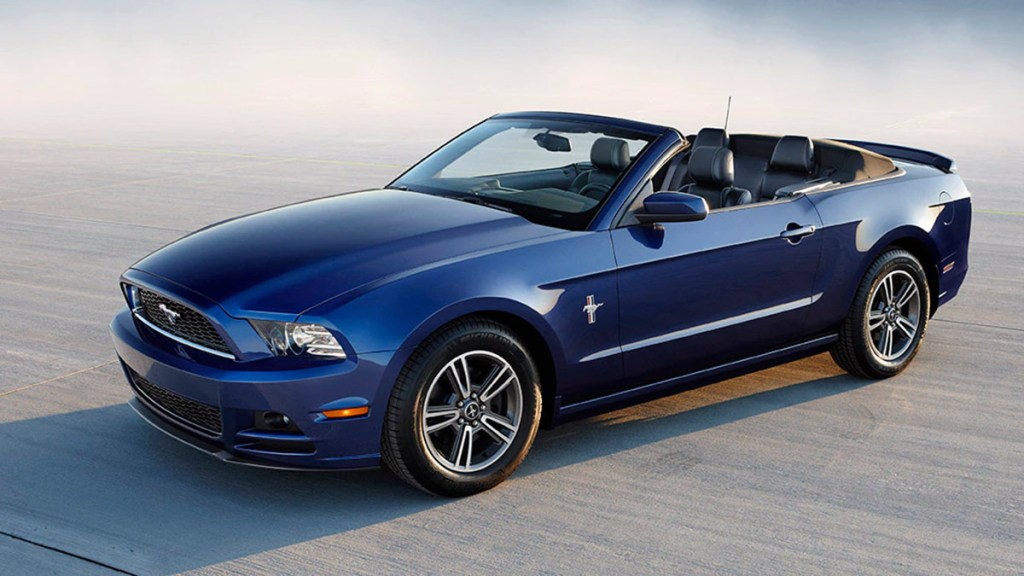
The 2012 Ford Mustang is a rear-wheel-drive sports car offered in four powertrain families: the V6 uses a 305-horsepower 3.7-liter Ti-VCT V6; the GT uses a 412-horsepower 5.0-liter Ti-VCT V8; the Boss 302 uses a 444-horsepower high-output 5.0-liter V8 with a 7,500-rpm redline; and the Shelby GT500 uses a supercharged 5.4-liter DOHC V8 producing 550 horsepower and 510 lb-ft of torque. Every 2012 Mustang comes standard with a six-speed manual transmission and a limited-slip rear differential; a six-speed automatic is available on the V6 and GT. This specifications table compares engine, drivetrain, EPA fuel economy, chassis, brakes, wheels and tires, exterior and interior dimensions, and capacities across the 2012 Mustang V6, GT, Boss 302, and Shelby GT500.
2012 Ford Mustang — Specifications by Model
▼Note: Figures below are grouped by model. The V6 column also covers V6 Premium, and the GT column also covers GT Premium (both share the same engine and chassis). Exterior, interior, and capacity dimensions are Ford-published figures for V6 and GT models; Boss 302 and Shelby GT500 dimensions may vary — see your dealer.
| Specification | Ford Mustang | |||
|---|---|---|---|---|
| V6 3.7L | GT 5.0L | Boss 302 5.0L HO | Shelby GT500 5.4L SC | |
| Engine | ||||
| Configuration | 3.7L DOHC V6, all-aluminum | 5.0L DOHC V8 | 5.0L high-output DOHC V8 | 5.4L DOHC 32-valve V8, supercharged |
| Valvetrain | DOHC, Ti-VCT (24-valve) | DOHC, Ti-VCT (32-valve) | DOHC, Ti-VCT (32-valve) | DOHC (32-valve) |
| Induction | Naturally aspirated | Naturally aspirated | Naturally aspirated | Supercharged & intercooled (9.0 psi) |
| Horsepower | 305 hp @ 6,500 rpm | 412 hp @ 6,500 rpm | 444 hp @ 7,400 rpm | 550 hp @ 6,200 rpm |
| Torque | 280 lb‑ft @ 4,250 rpm | 390 lb‑ft @ 4,250 rpm | 380 lb‑ft @ 4,500 rpm | 510 lb‑ft @ 4,250 rpm |
| Recommended Fuel | Regular unleaded | Premium (for rated output) | Premium (for rated output) | Premium (for rated output) |
| Drivetrain | ||||
| Drive Layout | Rear-wheel drive | |||
| Standard Transmission | 6-speed manual | |||
| Available Transmission | 6-speed automatic | 6-speed automatic | — (manual only) | — (manual only) |
| Standard Axle Ratio | 2.73:1 | 3.31:1 | 3.73:1 | 3.55:1 |
| Rear Differential | Limited-slip | |||
| Fuel Economy (EPA est. city / hwy / combined mpg) | ||||
| Manual | 19 / 29 / 22 | 17 / 26 / 20 | 17 / 26 / 20 | 15 / 23 / 17 |
| Automatic | 19 / 31 / 23 | 18 / 25 / 20 | — | — |
| Chassis & Brakes | ||||
| Front Suspension | Independent coil-over strut | |||
| Rear Suspension | Three-link solid axle with coil springs and Panhard rod | |||
| Stabilizer Bars | Front and rear | Front and rear | Front and rear (25‑mm rear) | Front and rear (SVT-tuned) |
| Steering | Selectable-effort electric power-assisted rack-and-pinion | |||
| Brakes | Four-wheel disc with Anti-Lock Brake System (ABS) | |||
| Performance Front Brakes | — | Brembo 14″ 4-piston (available) | Brembo 14″ vented, 4-piston | Brembo 14″ vented, 4-piston |
| Wheels & Tires | ||||
| Standard Wheels | 17″ aluminum | 18″ aluminum | 19″ (9″ fr / 9.5″ rr) aluminum | 19″ x 9.5″ forged aluminum |
| Standard Tires | All-season | Performance | Pirelli P Zero summer (255/40R19 fr, 285/35R19 rr) | Goodyear Eagle F1 Supercar |
| Spare | Tire mobility kit | Compact spare | — | — |
| Exterior Dimensions (V6 & GT; Coupe / Convertible) | ||||
| Wheelbase | 107.1 in. | |||
| Overall Length | 188.1 in. | |||
| Overall Width (excl. mirrors) | 73.9 in. | |||
| Overall Width (incl. mirrors) | 80.1 in. | |||
| Overall Height | 55.8 in. | |||
| Interior Dimensions (V6 & GT; Coupe / Convertible) | ||||
| Seating Capacity | 4 | |||
| Head Room (Front) | 38.5 / 38.8 in. | |||
| Shoulder Room (Front) | 55.3 in. | |||
| Leg Room (Front) | 42.4 in. | |||
| Head Room (Rear) | 34.7 / 36.5 in. | |||
| Shoulder Room (Rear) | 51.6 / 45.0 in. | |||
| Leg Room (Rear) | 29.8 in. | |||
| Capacities (V6 & GT; Coupe / Convertible) | ||||
| Passenger Volume | 83.3 / 81.0 cu. ft. | |||
| Luggage Capacity | 13.4 / 9.6 cu. ft. | |||
| Total Interior Volume | 96.7 / 90.6 cu. ft. | |||
| Fuel Capacity | 16.0 gal. | |||
Source: 2012 Ford Mustang brochure (Ford Motor Company). Specifications are for the 2012 model year and may vary with model, body style, transmission, and optional equipment. The V6 column also represents V6 Premium and the GT column also represents GT Premium, as each pair shares the same engine and chassis.
GT, Boss 302, and Shelby GT500 horsepower and torque figures are achieved on premium unleaded fuel. Fuel-economy figures are EPA estimates for city/highway/combined driving and are provided for comparison only; actual mileage will vary. The V6 automatic’s 31 mpg highway rating applies to the coupe; the convertible is rated 30 mpg highway. Exterior, interior, and capacity dimensions are Ford-published figures for V6 and GT models; Boss 302 and Shelby GT500 dimensions may differ.
Notable features of the 2012 Ford Mustang compared across six models: V6, V6 Premium, GT, GT Premium, Boss 302, and Shelby GT500. Highlights range from a standard six-speed manual, limited-slip rear differential, AdvanceTrac electronic stability control, and sequential LED taillamps to available Brembo brakes, leather-trimmed seats, MyColor illuminated gauges, Ford SYNC, the Shaker 500 and Shaker 1000 audio systems, a voice-activated navigation system, a rear view camera, HID headlamps, a glass roof, and RECARO sport seats. The track-focused Boss 302 adds five-way adjustable shocks and Brembo front brakes, while the supercharged Shelby GT500 adds an SVT-tuned suspension and standard HID headlamps. This table shows which features are standard, optional, or packaged on each 2012 Mustang model.
2012 Ford Mustang — Notable Features by Model
▼Note: The Boss 302 is a track-focused model that omits several comfort and convenience features to save weight, so it shows fewer standard luxuries than the GT Premium despite its higher performance. Many premium items are grouped into option packages (e.g., Comfort, Electronics, Brembo Brake, Laguna Seca, and SVT Performance packages).
S = Standard · O = Optional · P = Package · — = Not Available
| Feature | Ford Mustang | |||||
|---|---|---|---|---|---|---|
| V6 | V6 Prem. | GT | GT Prem. | Boss 302 | GT500 | |
| Mechanical & Performance | ||||||
| 6-speed manual transmission | S | S | S | S | S | S |
| 6-speed automatic transmission | O | O | O | O | — | — |
| Limited-slip rear differential | S | S | S | S | S | S |
| AdvanceTrac electronic stability control | S | S | S | S | S | S |
| Four-wheel disc brakes with ABS | S | S | S | S | S | S |
| Brembo 14″ front brakes (4-piston) | — | — | P | P | S | S |
| V6 Performance Package | P | P | — | — | — | — |
| Five-way adjustable shocks | — | — | — | — | S | — |
| SVT-tuned performance suspension | — | — | — | — | — | S |
| Exterior | ||||||
| Sequential LED taillamps | S | S | S | S | S | S |
| Automatic headlamps | P | P | S | S | S | S |
| Fog lamps | P | P | S | S | — | — |
| HID headlamps | P | P | P | P | — | S |
| Rear spoiler | O | O | S | S | S | S |
| Racing / appearance stripes | O | O | O | O | S | S |
| Glass roof (coupe) | O | O | O | O | — | O |
| Convertible body style available | S | S | S | S | — | S |
| Interior & Comfort | ||||||
| Leather-trimmed front seats | — | S | — | S | — | S |
| 6-way power driver’s seat w/ lumbar | — | S | — | S | — | S |
| Heated front seats (Comfort Package) | — | P | — | P | — | — |
| RECARO sport seats | — | — | — | — | O | O |
| Leather- or Alcantara-wrapped steering wheel | — | S | — | S | S | S |
| MyColor 6-gauge illuminated cluster | — | S | — | S | — | S |
| Ambient lighting | — | S | — | S | S | S |
| Dual-zone automatic climate control | P | P | P | P | — | P |
| Technology & Infotainment | ||||||
| Ford SYNC voice-activated connectivity | — | S | — | S | — | S |
| Shaker 500 audio (8-speaker, 500W) | — | S | — | S | — | S |
| Shaker 1000 audio (10-speaker, 1,000W) | — | O | — | O | — | O |
| Voice-activated Navigation System | P | P | P | P | — | P |
| SiriusXM Satellite Radio | — | S | — | S | — | S |
| Rear view camera | O | O | O | O | — | O |
| Reverse Sensing System | P | P | P | P | — | P |
| Safety & Security | ||||||
| Dual-stage front & front side airbags | S | S | S | S | S | S |
| MyKey owner controls | S | S | S | S | S | S |
| SecuriLock passive anti-theft | S | S | S | S | S | S |
| Tire Pressure Monitoring System | S | S | S | S | S | S |
| SOS Post-Crash Alert System | S | S | S | S | S | S |
Source: 2012 Ford Mustang brochure (Ford Motor Company). S = Standard, O = Optional, P = Package, — = Not Available. This is a curated set of notable and differentiating features, not the complete factory equipment matrix. Availability may vary with body style, transmission, equipment group, and standalone options.
Several items are grouped into option packages: fog lamps and automatic headlamps on the V6 come via the Pony/appearance packages; heated front seats are part of the Comfort Package; dual-zone climate, HD Radio, and the voice-activated Navigation System are part of the Electronics Package; and Brembo front brakes come via the Brembo Brake Package on the GT and GT Premium. The Boss 302 is a track-oriented, coupe-only model that intentionally omits many comfort and convenience features to reduce weight.
Model-Year Changes
2014: The Boss 302 is dropped, while the Shelby GT500 carries over with its 662-hp supercharged 5.8-liter V8.
2013: The 5.0-liter V8 also gains more power, and new options include a Track Apps package and upgraded audio options.
2012: The 444-hp Boss 302 debuts, along with a new selectable steering system with Sport, Comfort, and Standard modes.
2011: Two new engines debut: the 3.7-liter V6 and 5.0-liter V8. Both offer new 6-speed manual or automatic transmissions, with the V6 receiving a limited-slip differential as standard. Also new are improvements to the Mustang’s suspension, steering, and body rigidity.
2010: The Mustang gets a major makeover, touting an aggressive new front end, improved interior materials, new features and options, and the addition of electronic stability control.
2009: A panoramic fixed glass roof joins the option sheet.
2008: New options include HID headlights and a lighting package, while side airbags become standard.
2007: New features include available heated front seats and navigation. All radios gain satellite radio and an auxiliary input jack.
2006: V6 models offer the Pony Package, which includes upgraded suspension, wheels, fog lamps, and traction control.
See 2005-2014 Ford Mustang models for sale near you
Is the Ford Mustang a Good Car?
There’s no arguing with the Mustang’s performance and value, and fifth- and sixth-generation cars have solid reliability scores. That said, we recommend opting for a 2018 or newer Mustang to get to newer drivetrains and technology improvements.
How Fast Is the Ford Mustang?
The record for the fastest production Mustang belongs to the Mustang GTD. It can sprint to 60 mph in under three seconds, has a top speed of 202 mph, and joins an exclusive club of cars to lap the famed Nürburgring in under seven seconds. Other notable high-performance Mustang models include the Shelby GT350 and GT500, Boss 302, Mach 1, and SVT. Even the stock GT can run from zero-to-60-mph time in roughly four to five seconds, depending on the year.
Does the Ford Mustang Offer All-Wheel Drive?
No. The Mustang has been exclusively a rear-wheel drive (RWD) car since the beginning.
Does the Ford Mustang Offer a Convertible?
Except for the second generation, Ford has always offered a convertible option for the Mustang.
What Are the Most Desirable Years for the Ford Mustang?
The sixth generation is probably the most desirable due to its numerous trim ranges and special editions, advanced safety systems, and overall design. Among the older models, the 1987-and-later third-generation years have gained a loyal following, especially the V8 models.
What Are the Years to Avoid for the Ford Mustang?
The second-generation Mustang is one of the least desirable models, and its underpowered engine options are a big part of that disdain. Many enthusiasts also shy away from the fourth generation due to quality issues, low-rent interior materials, and transmission problems.
More recent models can be better, though 2015-2016 models with turbocharged EcoBoost 2.3-liter engines have had several recalls. View all Mustang recalls for any year on the National Highway Traffic Safety Administration’s website.
Visit our Car Buying Information Center for curated articles and resources to help you go into your car deal with confidence.
Editor’s Note: We have updated this article since its initial publication.


How are fox bodies least desirable 🤯growing up as teenager in the 90s everyone had foxes….an alot of ppl race them today
I had a 68 289 V-8 with 3 speed on the floor and my friend had a 289 straight 6 with 3 speed on the floor. When I was teenager and my first experience driving in Seattle in that 68 Mustang… I loves the hills in down town seattle… I could catch air…. or racing a porsche 911 on westlake and going into a four wheel drift around the corners. The porsche won due to the fact I had to lock it up into a sideways skid stop because people in the cross walk, the porsche just grabbed another gear since they had just stepped out of his way. I think when I left seattle to go back to eastern washington I got a police escort until I lost them…. lol
Um Doug? I think you mis printed something…You stated that your friend had a “289 straight 6″…just think about what you just said…
“The Mustang started with a $2,300 sticker price and a 170-cu-in V8” Wrong. It was a six cylinder..
I LOVE my 2004 Mustang GT Convertible, & my 2006 Mustang Special Edition “Bumble Bee”, a former Hertz Rental Car. My GT has only 57,000 on it. I’ve owned a 2000 Camaro Z-28 Convertible, & a 2002 Pontiac Trans Am, but they BOTH had continual issues & visits to the dealers.