




Used Subaru Forester Quick Facts
- The best years for a used Subaru Forester are 2020-2024, and if you’re looking for something more affordable without compromising on modern safety tech, consider 2016-2018.
- Early generations offer options like a turbocharged engine and a manual transmission.
- Since the Insurance Institute for Highway Safety (IIHS) began considering SUVs for its Top Safety Pick and Top Safety Pick+ lists in 2007, the Subaru Forester has qualified for one or the other.
The Subaru Forester is a well-regarded compact SUV. It’s standard all-wheel drive (AWD), enviable safety record, and excellent resale and reliability ratings keep used models in high demand. Fortunately, the Forester is one of Subaru’s best-selling vehicles, meaning there should be a plentiful supply in the used car market.
Like all cars, some years are better than others. Early Forester models are notorious for blown head gaskets, while some newer versions have carbon buildup issues and problematic continuously variable automatic transmissions (CVT). A few generations also offer a turbocharged engine, a feature some may find enticing, as the normally aspirated Forester is not known for its rapid acceleration.
Let’s dive a little deeper and see which Forester best fits your lifestyle and budget.
- What Is the Best Model-Year Used Subaru Forester?
- Subaru Forester by Generation: Which Should You Buy?
- Is the Subaru Forester Reliable?
- Can You Go Off-Roading in a Subaru Forester?
- Does the Subaru Forester Have a Hybrid Option?
- How Much Can the Subaru Forester Tow?
- What Are the Most Reliable Years for the Subaru Forester?
- What Are the Worst Years for the Subaru Forester?
What Is the Best Model-Year Used Subaru Forester?
If you’re seeking the latest in safety tech and capability, a 2020-2024 Forester is your best bet. These years are fairly reliable, offer numerous driver-assist systems, and span a wide range of trims and capabilities. We like them because, unlike the 2025 models, they have a smaller infotainment touchscreen and physical climate control knobs and buttons. For those on a tighter budget, certain third- and fourth-generation models are good choices. However, for higher-mileage models, be sure to have a qualified mechanic inspect the car before you buy. You’ll want them to check the condition of the CVT, head gaskets, and some suspension parts, as well as look for signs of excessive oil consumption and underbody rust in areas where road salt is used during winter.
Since the Insurance Institute for Highway Safety (IIHS) began considering SUVs for its Top Safety Pick and Top Safety Pick+ lists in 2007, the Subaru Forester has qualified for one or the other.
See used Subaru Forester SUVs near you.
Subaru Forester by Generation: Which Should You Buy?
Sixth Generation: 2025-Current
It’s too early to rate the sixth-generation Forester, as it was just introduced for the 2025 model year. However, regarding the powertrain, AWD system, and safety features, the sixth-generation Forester largely mirrors the fifth generation, meaning you can expect the same high quality, reliability, and year-round driving confidence. A hybrid engine joins the lineup for the 2025 model year, which should help improve performance and city fuel economy figures.
Beyond changes to the sheetmetal, the sixth-generation Forester adds the 11.6-inch infotainment touchscreen found in other Subaru products (think Crosstrek and Outback). It also enhances the EyeSight driver assistance suite, provides improved sound insulation, and comes with additional standard equipment.
One Caveat: the 2025 Forester Wilderness retains the fifth-generation platform, so if you’re looking for a more modern Wilderness, you’ll need to look at the 2026 model.
See 2025 to current Subaru Forester SUVs near you.
Fifth Generation: 2019-2024

It’s easy to recommend the 2020-2023 model years. All three posted solid scores for reliability and owner satisfaction. The 2019 version suffers from a few issues best chalked up to first-year teething problems. This generation has a few issues with rough shifting CVTs, problems with a failed thermo control valve, premature window regulator failure, glitchy touchscreen infotainment systems, and windshields that seem to crack easily.
Most, if not all, of these issues are covered either under warranty, by a TSB (technical service bulletin), or a recall.
Somehow, Subaru figured out how to make this generation Forester bigger on the inside without making it noticeably larger on the outside. The rear-seat legroom has increased by 1.4 inches, and an additional inch separates the two front seats. The 2.5-liter turbocharged engine is no longer available, leaving the 182-horsepower 2.5-liter normally aspirated engine to propel the entire Forester lineup. A continuously variable automatic transmission (CVT) still transfers engine torque to all wheels, but Subaru has made it lighter and quieter by simulating upshifts and downshifts during aggressive driving. The Forester has earned an Insurance Institute for Highway Safety (IIHS) Top Safety Pick/Top Safety Pick+ in most years since 2007.
There are six trims to choose from: Base, Premium, Sport, Limited, Touring, and Wilderness.
The base is a simple concept and the most affordable of the group. It comes standard with the EyeSight driver-assist suite (automatic emergency braking, adaptive cruise control, lane-centering, lane-keeping, lane departure warning), automatic climate control, LED headlights, and a 6.5-inch infotainment touchscreen featuring Apple CarPlay and Android Auto.
The Premium hits the sweet spot, adding a panoramic sunroof, alloy wheels, 10-way power driver’s seat, rear seat air vents, and X-Mode. Options for the Premium include the Cold Weather Package (heated seats, mirrors, and wipers), a blind-spot monitor with rear cross-traffic detection, keyless access with push-button start, and a power liftgate.
The Sport adds 18-inch alloy wheels, unique styling, the All-Weather Package, keyless access, automatic high beams, and SI-Drive. Notable options include an 8-inch infotainment touchscreen, Harman Kardon audio, and reverse automatic braking.
The Limited features leather upholstery, dual-zone automatic climate control, a power liftgate, and steering-responsive headlights. Options include navigation, a heated steering wheel, and the Harman Kardon audio system.
The Touring builds off the Limited, offering black or saddle brown leather, a power passenger seat, memory driver’s seat, heated rear seats, a heated steering wheel, and navigation.
The Wilderness builds off the Sport, adding more ground clearance, increased towing ability, all-terrain tires, additional cladding, water-resistant upholstery, and a ladder-type roof rack that can hold up to 800 pounds.
Model-Year Changes:
2024: Premium and Limited trims gain more standard equipment.
2023: No significant changes.
2022: All Foresters get revised styling, updated EyeSight cameras, and stronger roof rails. The Wilderness trim joins the lineup.
2021: New standard equipment includes steering-responsive headlights, automatic high beams, and a rear seatbelt reminder. The Premium trim gains keyless entry/push-button start, as well as fog lights, while the Sport adds blind-spot monitoring and rear cross-traffic detection.
2020: The EyeSight system gets some upgrades.
See 2019-2024 Subaru Forester SUVs near you.
Fourth Generation: 2014-2018

Virtually every aspect of the fourth-generation Forester sees improvement. Larger inside and out, the maximum cargo space balloons to 74.7 cubic feet. Subaru carries over the base engine but replaces the old turbo with a new 2.0-liter direct-injection turbo that generates 250 hp. Gone are the 5-speed manual and 4-speed automatic transmissions, replaced by a 6-speed manual and a CVT. All trims, beginning with the 2.5i Limited grade, get X-Mode with hill descent control to maximize performance and low-speed operational capabilities on inclines and slick surfaces. Subaru’s EyeSight bundle of advanced safety tech becomes available.
Model years 2014-2017 made the IIHS Top Safety Pick+ list. The 2018 Forester made the Top Safety Pick list. Other model-year improvements or changes:
For this generation, issues with blown head gaskets, CVT failure, catalytic converter failure, sluggish infotainment systems, broken coil springs, and excessive oil consumption are among the biggest complaints.
Model-Year Changes:
2018: The available (standard on Touring) EyeSight system adds reverse automatic braking and high-beam assist.
2017: Turbocharged models receive an updated torque-vectoring all-wheel-drive (AWD) system with improved traction. Blind-spot monitoring is optional.
2016: The Starlink touchscreen infotainment interface becomes standard across all trim levels, with a 6.2-inch screen on the base model and a 7-inch screen on upper grades.
2015: All Forester trim levels get a backup camera.
See 2014-2018 Subaru Forester SUVs near you.
Third Generation: 2009-2013

More rear legroom and a quieter ride are some of the results of the third-generation Forester’s debut. It rides on an all-new platform with a double-wishbone rear suspension. With its softened lines, the fresh exterior styling gives the Forester a more sophisticated, if not more aggressive, appearance. It’s taller and longer, too. Subaru carries over the base (now with 170 hp) and the turbo engines from the previous generation. The base trim offers a 5-speed manual transmission; all others get a 4-speed automatic. Ground clearance increases to 8.7 inches.
This generation makes the IIHS Top Safety Pick list for all five model years.
We are hard-pressed to pick the best model year of this generation, and not because they are all so good. However, we will indeed pick one because we said we would. As they say, in the land of the blind, the one-eyed man is king. In this case, that would be the 2012 model year. It has average reliability and owner satisfaction scores and fewer recalls (15) than the average for this generation (15.6). Yes, this is the Forester’s recall generation.
Model-Year Changes:
2013: A new radio with built-in Bluetooth and streaming capabilities becomes standard on all 2.5X models.
2012: The passenger seat in all trims is now height-adjustable.
2011: Touring makes its debut as a trim level. A new base 2.5-liter engine delivers the same horsepower but ups the torque a tad and improves mileage.
2010: All trims receive a new instrument cluster. The L.L. Bean trim disappears.
See 2009-2013 Subaru Forester SUVs near you.
The Early Years (1998-2008): Generations 1 and 2
2003-2008

For its 2003 redesign, Subaru increased the Forester’s height and jettisoned the first generation’s Toontown grilles in favor of a more conservative 2-slat design. An aluminum hood reduces the poundage. Cargo space grows to a maximum of 64 cubic feet with the second row folded. Subaru renames the trims 2.5X and 2.5XS. The number and names of the trim levels fluctuate wildly during this generation, from as few as three to as many as seven. The IIHS didn’t begin testing SUVs for its Top Safety Pick and Top Safety Pick+ awards until 2007; however, the IIHS included the 2007 and 2008 Subaru Outback models on its Top Safety Pick list.
Owner satisfaction scores are high for the 2003-2006 model years and moderate for 2007 and 2008. Although 2003 had three recalls (the most of any model year from this generation), it ranked highest for reliability. Our nod for best from this group is the 2003 model year.
See 2003-2008 Subaru Forester SUVs near you.
1998-2002
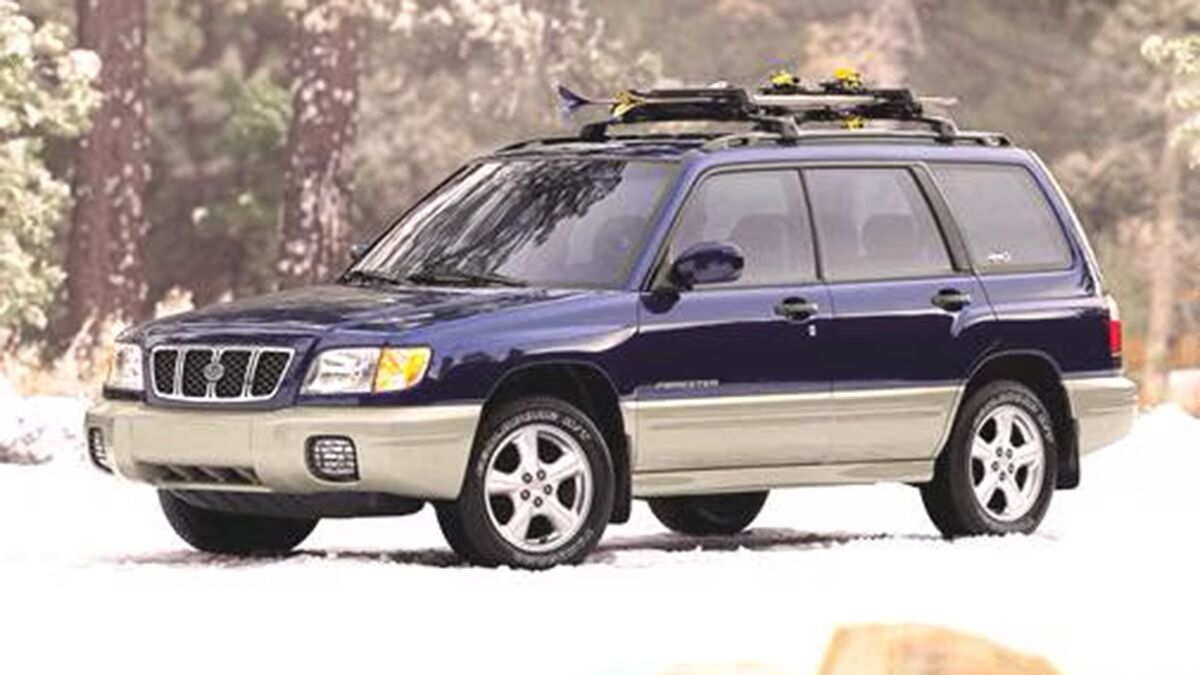
Sharing a platform with the Impreza and its 165-hp 2.5-liter 4-cylinder engine with the Outback, the first-gen Forester provides 7.5 inches of ground clearance. It, of course, propels itself with Subaru’s Symmetrical all-wheel-drive system. Hustling engine output to the wheels is available with either a 5-speed manual or a 4-speed automatic transmission. Subaru separates the Forester into three grades: Base, L, and S. Even the Base trim features air conditioning and a tilt steering wheel.
Reliability and owner satisfaction scores for this generation are at best sketchy. You need to know that, generally, Subaru has one of the most loyal owner bases in the industry. So, even first-gen Forester models get lots of love from those who drive or have driven them.
See 1998-2002 Subaru Forester SUVs near you.
Is the Subaru Forester Reliable?
Overall, we’d say the Forester is generally reliable. Please keep in mind that, more than anything, long-term reliability is a function of how previous owners have treated and maintained a used vehicle. Furthermore, we recommend getting an inspection by a professional mechanic.
Can You Go Off-Roading in a Subaru Forester?
Although it’s not engineered for intense off-roading, it can get you to the trailhead for hiking and biking. It’s fine on dirt and gravel trails, as well as snow. If you want a little more, we suggest the newer Wilderness. These offer the most off-road capability of all the model years.
Does the Subaru Forester Have a Hybrid Option?
A hybrid was announced for 2025. It’s the first for a Forester and promises fuel economy figures in the mid-30s around town and on the highway. The hybrid should also provide a bit more power for passing and accelerating.
How Much Can a Subaru Forester Tow?
Towing capability for any particular model is primarily a function of the engine and transmission. Furthermore, the maximum towing weight can vary depending on whether or not the load (trailer) has its own brakes. Prior to 2014, the Forester could tow between 2,000 and 2,400 pounds, depending on the model year. From 2014 until the present, the limit is 1,500 pounds. However, with the introduction of the Wilderness trim in 2022 and through 2025, the Forester can tug up to 3,000 pounds, with 2026 Forester models rated at 3,500 pounds.
What Are the Most Reliable Years for the Subaru Forester?
The most reliable years for the Forester include 2020-2024 (fifth generation), 2016-2018 (fourth generation), and 2012-2013 (third generation).
What Are the Worst Years for the Subaru Forester?
Out of the 25 model years we’ve researched for reliability and owner satisfaction, there are only a handful we wouldn’t recommend. The 2003 through 2006 models have issues with blown head gaskets, airbag recalls, failed catalytic converters, and some rust problems. The third-generation models, especially 2010 and 2011, have some issues with blown head gaskets, oil consumption, and steering rack leaks, while the 2014 and 2015 cars have issues with the CVT, problematic manual transmissions, and excessive oil consumption due to defective piston rings.
See new Subaru Forester SUVs for sale near you.
Editor’s Note: This article has been updated since its initial publication.


