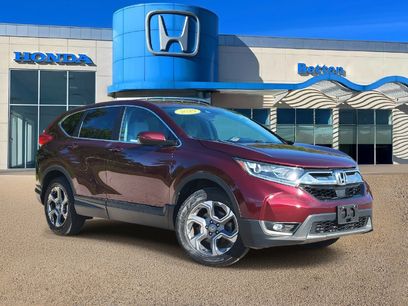
It wouldn’t be surprising if your compact SUV search begins and ends with the 2017 Honda CR-V. Completely redesigned this year, it enhances the things people already loved about its best-selling predecessor while refining areas in need of improvement. Sure, there weren’t many, but a higher-quality interior, better tech features and more attractive styling clearly make for a better vehicle. Really, it’s hard to think of areas where the new CR-V falls short in meeting the needs of its diverse group of loyal buyers (not to mention new ones as well). Now, as for excellent areas that were improved, the 2017 CR-V is a bit bigger than before, which is best seen in the backseat that grows by two inches of legroom. There’s also even more cargo capacity to give it best-in-class status, while the front center console has been cleverly redesigned to better accommodate big and small items. A new turbocharged engine found on most trim levels boosts fuel economy, while the driving experience is altogether more comfortable and refined. It just feels like a more grown-up, sophisticated vehicle. And not just in comparison to the 2016, but to competitors like the Toyota RAV4, Subaru Forester and Ford Escape as well. Taking a look at those is still recommended, but we wouldn’t be surprised if you end up circling back to the new CR-V.
Autotrader’s Advice:
Unless you have to get leather or heated seats, the EX trim level is the way to go. You'll get a massive increase in desirable feature content along with better fuel economy. As the volume-selling trim level, you should also be able to easily find one in the right color and at the right price.
What We Like:
Class-leading passenger and cargo space; efficient engines; refined driving experience; clever storage; widely available safety tech.
What We Don’t:
No higher-performance engine option available.
Original MSRP:
$24,000-$33,700 (when new).
MPG:
The base CR-V LX trim is powered by a 2.4-liter 4-cylinder engine that produces 184 horsepower and 180 lb-ft. of torque. Despite being the base engine, that’s actually quite a competitive output and acceleration is relatively strong. Its fuel economy is at 26 miles per gallon in the city, 32 mpg on the highway and 28 mpg in combined driving with front-wheel drive. All-wheel drive (AWD) decreases each figure by 1 mpg. Every other trim comes with a 1.5-liter turbocharged 4-cylinder good for 190 hp and 179 lb-ft. That output is indeed similar to the base engine, and although the two behave differently, acceleration between the two is ultimately similar. Instead, the turbo engine’s advantage is fuel economy, returning 28 mpg city/34 mpg hwy/30 mpg combined (FWD). Again, AWD sacrifices 1 mpg in each cycle.
Standard Features & Options:
The 2017 CR-V comes in a single five-passenger configuration and is offered with four trim levels: LX, EX, EX-L and Touring.
The
2017 CR-V LX ($24,000, when new) basically comes equipped with the basics, though does include 17-inch alloy wheels, LED running/accent lights, automatic climate control, a rearview camera, Bluetooth, two USB ports and a 4-speaker sound system.
The
2017 CR-V EX ($26,700, when new) is the trim most people end up with, which isn’t surprising given its dramatic uptick in equipment. It adds the turbocharged engine described above plus 18-in wheels, foglights, keyless start, remote ignition, rear privacy glass, a sunroof, a cargo cover, dual-zone automatic climate control, an 8-way power driver seat, heated front seats, a pair of second-row USB charging ports, a 7-in touchscreen, a 6-speaker sound system, satellite radio, Apple CarPlay and Android Auto. Also included is a package of accident avoidance tech consisting of blind-spot, rear cross-traffic, lane-departure and forward collision warning systems, plus automatic emergency braking, lane-departure prevention, automatic high beams and adaptive cruise control with traffic-friendly slow-speed follow capability.
The
2017 CR-V EX-L ($29,200, when new) adds a power liftgate, leather upholstery, driver memory settings, a 4-way power passenger seat, a leather-wrapped steering wheel, HD radio and an 8-speaker sound system. A navigation system can be added to the existing touchscreen.
The
2017 CR-V Touring ($32,400, when new) steps things up with roof rails, LED headlights, automatic wipers, a hands-free power liftgate, a sound system subwoofer and the navigation system.
Safety:
The 2017 Honda CR-V comes standard with the usual allotment of safety equipment: antilock brakes, stability and traction control, front airbags, front-side airbags and side-curtain airbags that cover both rows. There are also LATCH anchors in all three rear positions. All but the base LX comes standard with blind-spot, rear cross-traffic, lane-departure and forward collision warning systems, plus automatic emergency braking and lane-departure prevention. This sort of equipment is almost always optional on competitors, and often then restricted to top trim levels. The nonprofit Insurance Institute for Highway Safety named the CR-V a Top Safety Pick+ for its top scores in all relevant crash and crash-prevention categories. The government had not crash tested the CR-V at the time of this writing.
Behind the Wheel:
Drive the 2016 and 2017 CR-V back-to-back and it’s easy to feel the difference between the two SUVs. The new version feels more grown-up and sophisticated, with a more comfortable and controlled ride, a quieter cabin and steering that needs fewer corrections when on the highway. Indeed, this observation doesn’t just apply when comparing the 2017 model to its predecessor, but to the entire compact SUV field as well. Now, the new CR-V’s steering doesn’t feel quite as sharp or responsive to inputs, but ultimately its handling has been improved thanks to upgraded suspension components. As for the engines, both provide sufficient power and acceleration. This isn’t the slow CR-V of old, but the availability of a more powerful engine option would meet a demand met by the Ford Escape and Subaru Forester. The turbocharged 1.5-liter found in most trim levels feels a bit stronger when pulling away from a traffic light or when passing in traffic, but really, you’ll be fine with either. As for your passengers, they will enjoy unmatched interior comfort and space for this segment. Its additional two extra inches of rear legroom makes what was already an extremely family friendly SUV even better, as does the increase in cargo capacity and the clever front center console. The considerable improvement in interior material quality is also appreciated, as is Honda‘s improved touchscreen interface featuring additional menu shortcut buttons and a volume knob.

 Learn more